

Book Review: Disciple Making Is . . ., by Dave Earley and Rod Dempsey
August 12, 2015


August 12, 2015
Dave Earley and Rod Dempsey, Disciple Making Is . . . : How to Live the Great Commission with Passion and Confidence. B&H Academic, 2013. 320 pages. $24.99.
What does it mean to make a disciple? What does it mean to be a disciple? How are these questions related to the local church and the Great Commission? These are questions seminary professors and pastors Dave Earley and Rod Dempsey answer in their book, Disciple Making Is … How to Live the Great Commission with Passion and Confidence.
The trajectory of ministry in the local church must move toward engagement in the Great Commission. The authors advance their argument by first setting a path that covers biblical and theological foundations of discipleship. From this data, the authors come to a definition of discipleship: “A disciple is a person who has trusted Christ for salvation and has surrendered completely to him. He or she is committed to practicing the spiritual disciplines in community and developing to their full potential for Christ and his mission” (28).
Churches need to instruct disciples to follow Jesus’ commands. Building on the classic discipleship text by A. B. Bruce, the authors emphasize how Jesus made disciples. The authors create a helpful visual based on Bruce’s work that emphasizes declaring, developing, and deploying disciples (61). The process of discipleship begins with committing to Christ through faith and repentance. Then, disciples follow Jesus through apprenticeship with other believers. Finally, disciples are deployed as leaders to multiply and make other disciples. The authors are particularly helpful in encouraging pastors to raise up leaders who multiply disciples (chapters 16-18).
The final section of the book evaluates different church models and whether or not these models facilitate biblical discipleship (chapters 19-29). These are the chapters that will engage 9Marks readers most. They’re filled with insightful analysis on four church models: traditional, attractional, missional, and a hybrid of these models. Especially helpful is a 25-point list of what characterizes each model and how each model differs.
Near the end of the book, Earley and Dempsey rightly challenge churches to consider whether or not they’re willing to follow Christ’s commands of discipleship. That said, they also wisely caution against churches making drastic changes too quickly.
I see four major takeaways from this book.
Earley and Dempsey frame the discipleship discussion with this statement: “While it is true that many books have been written on this topic, there are few written from the conviction that the church is the essential environment for being and making disciples of Jesus” (ix). With a chapter devoted to the centrality of the local church (chapter 4) and multiple chapters analyzing different church models (chapters 19-29), the authors essentially make good on their claim that “the church is the relational context for disciple making” (71). The authors don’t deny personal discipleship or small group discipleship, but they make sure to emphasize that those variations of discipleship must take place within the local church. For example, they write, “The church must be in the absolute middle of God’s global plan of making disciples” (39). And, “The church must be intentional in developing all of God’s children to reach their full potential” (41). In other words, disciple-making is the reason the church exists.
If churches are healthy, then they’re making disciples, and if they’re making disciples, then they should naturally be planting churches. Citing other discipleship and church planting strategists such as Aubrey Malphurs and Ed Stetzer, Earley and Dempsey make a compelling case for church planting. They write, “The fulfillment of the Great Commission always and ultimately results in church planting” (6).
Following Jesus means obeying his commands. Obeying Jesus evidences one’s love for him. This is Jesus’ logic for discipleship. The authors capture this logic and then helpfully tease it out over six chapters. In sum, they write, “We cannot say that we are fulfilling the Great Commission until we are teaching our disciples to ‘observe everything Jesus commanded’” (47-48).
Pastors must give themselves to developing disciples. The authors communicate this when they write, “Christian discipleship and Christian leadership are inexorably linked” (203). Pastors must identify and equip leaders to follow God’s plan of fulfilling the Great Commission. Earley and Dempsey connect leadership to the discipleship process: “A Christian leader is a person of influence. He or she follows God’s vision for his or her life, and influences others to follow God’s plan for their lives” (198). The vision? The plan? Making disciples.
The authors want to find the best in various church models while remaining biblically faithful to the data we have in the New Testament. At the same time, they aren’t afraid of shying away from critical evaluation. What follows are some quotations that prove this.
There’s a helpful two-page chart that covers 25 different aspects of each model that should spark interesting conversation for church staff or elders meetings (236-237).
If there’s a major area of needed improvement in the book, it’s that the authors don’t satisfactorily address all the necessary connections between discipleship and the church. For example, they don’t address or barely address questions of when to baptize, how to connect accountability to discipleship and church membership, or the importance of church discipline. These are questions many pastors ask.
Overall, however, Earley and Dempsey offer a helpful book on discipleship that will excite and challenge church leaders to obey Jesus Christ and be on mission in fulfilling his Great Commission.

If we affirm the regulative principle for the Sunday morning gathering, shouldn’t we also apply the same conviction to the rest of our discipleship ministries?

Christian work that stops at evangelism misunderstands not only what they’re called to, but what God is up to in the lives of his people.

By developing other leaders who can teach, disciple, evangelize, counsel, and shepherd the flock, you raise up others who can care for the health of all the church members.
In Planting by Pastoring, author Nathan Knight challenges our view of church planting and centers the goal of pastoral ministry on a basic biblical foundation: a church plant is in fact a church, and a planter is in fact a pastor.
As churches rapidly expand, Christians risk viewing the church with an entrepreneurial mindset. Church planters can be tempted to fixate on gaining numbers and achieving financial stability as their only metrics for success. They fail to focus on lifting up Christ’s people within the church.
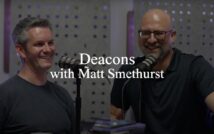
What is a deacon? What does a deacon do? In this second 9Marks Book Club, Jonathan Leeman and Matt Smethurst discuss the important topic of deacons in a local church. Buy the book here: https://9marks.myshopify.com/products…