

How Should Christians Think about the Law of Moses?


July 9, 2026

July 9, 2026
Abstract: Samuel Parkison and Ryan Currie review Paul Sloan’s Jesus and the Law of Moses, a book arguing that central to Christ’s ministry in the Synoptic Gospels is his role as the eschatological Messiah who comes to bring about the restoration of Israel. While Parkison and Currie acknowledge some strengths of the book, they offer some significant critiques of Sloan’s work, particularly in regard to: his representation of the gospel-law distinction in the Reformed tradition; the implications of his views for Christology; the claim that Jesus expects Jewish believers to continue keeping the law as an expression of allegiance to him; and the question of whether Jesus’s death should be viewed as an atoning sacrifice. Sloan’s claims about Jesus and the law misunderstand the Bible’s teaching about the newness of the New Covenant and the way in which Christ fulfills the Old Testament.
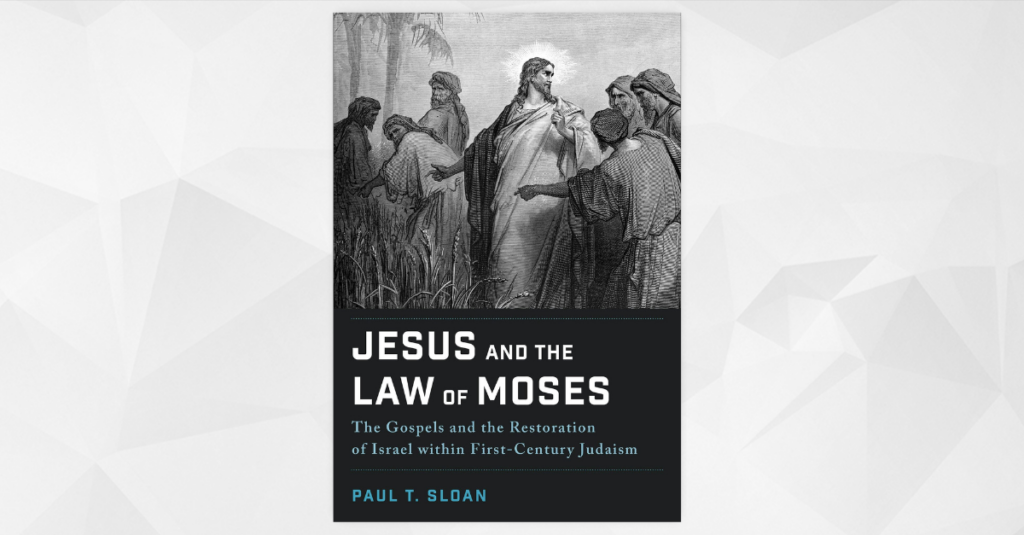
Paul T. Sloan, Jesus and the Law of Moses: The Gospels and the Restoration of Israel within First-Century Judaism. Baker Academic, 2025. 288 pages.
Scholars hope their work will receive a wide readership and have an impact on the status quo, but it’s often difficult to tell which works will make a splash. One recent work that fits that description is Paul T. Sloan’s Jesus and the Law of Moses: The Gospels and the Restoration of Israel Within First-Century Judaism (Baker Academic, 2025).
On one level, it is not difficult to understand why many have received Sloan’s work so warmly. Rather than boring and stilted academic writing, Sloan offers lucid prose with humor and personality. You almost want him to be right. The book breathes with eloquence and ease.
But Sloan’s strengths are not merely stylistic. He holds up Jesus as the interpreter of the Mosaic law and the one who restored Israel from exile. In the process, he provides insight after insight into Jesus’s handling of the law. However, the insights and eloquence are mixed with serious errors. Sloan’s analysis is problematic in its presentation of the law-gospel distinction, in its Christology, in its insistence on continued law-keeping for Jews, and in its denial of Christ’s death as a sacrifice of atonement. We will consider each of these shortcomings, but first we’ll highlight some of the book’s strengths.
Sloan’s thesis is that central to Christ’s ministry in the Synoptic Gospels is his role as the eschatological Messiah who comes to bring about the restoration of Israel. Christ is an authoritative interpreter of the law who adjudicates debates on how to apply the law’s ordinances in light of the eschatological Jubilee (see Lev. 25) he brings in with Israel’s restoration. If Sloan is right, then some of the more popular presentations of Jesus’s disputes with the Pharisees are misleading. Sloan takes umbrage, for instance, with the notion that Jesus’s criticism of the Pharisees is something like, The Pharisees love the law too much. Rather than minimizing or disparaging the law, Sloan insists that Jesus is often correcting the Pharisees’ misinterpretation of the law (whether that’s because they fail to recognize who he is, or because they fail to recognize the eschatological significance of his coming).
In other words, many of the showdowns between Jesus and the Pharisees are not debates between those who love the law too much (the Pharisees) and someone who loves God more (Jesus); rather, they are intramural debates between those who love the law yet disagree on how to interpret and apply it. According to Sloan, Christ’s main criticism of the Pharisees is not that they idolized the law but that they didn’t know “what time it was” and therefore didn’t interpret the law rightly. The eschatological restoration of Israel was upon them, but they were seeking to apply the law in ordinary times. Sloan writes, “It seems that Jesus treats the Sabbath as a microcosm of the Jubilee he heralds, and thus he claims that it is not just permissible but necessary that on the Sabbath he do what the Sabbath qua Jubilee requires” (131). What Sabbath and Jubilee require is the release of bondage from the domain of Satan and death. This is why, as Sloan convincingly demonstrates, Christ’s healings all correspond to the reversal of Levitical curses.
Some of Sloan’s best moments are nestled in this demonstration of Jesus as the divinely authorized teacher and interpreter of the law. This is seen especially in his treatment of the “permitted profanations” of the law, as when his disciples plucked heads of grain on the Sabbath (Matt. 12:1–8). Jesus’s actions have precedence: “David and the priests have ‘violated’ the law, but they show that in some cases violations are permitted” (159). Just as David and the priests may profane the Sabbath or violate the law because of a greater or situation-specific command, so also Jesus’s “mission takes precedence over otherwise good rituals and commandments” (149). Sloan goes on to argue that Jesus’s work is “commissioned and that such a commissioning is at least on par with the temple” (138). The “something greater than the temple” (Matt. 12:6) does not refer specifically to Jesus himself but to Jesus and the disciples’ mission.
The strength of Sloan’s argument comes with a necessary caveat. It is not simply that Jesus’s commissioning is on par with the temple and parallel with David’s, or the priests’, commissioning, as Sloan emphasizes; Jesus is also Lord of the Sabbath and the fulfillment of the temple. He is inaugurating a new eschatological reality and era in the New Covenant, which the law pointed to all along. Sloan agrees. However, he goes on to argue that Jesus, as Lord of the law, reestablishes the law and restores God’s people to a form of law observance. And this brings us to a few serious criticisms of Sloan’s work.
Our first objection, though by no means the most significant, is that Sloan sets up a false foil when he contrasts his approach with the law-gospel distinction articulated in the Reformed tradition. The kind of false contrast described above—between a laid-back Jesus and the uptight Pharisees—may be more common at a popular level (or for certain strains in the Reformed tradition), but it does not characterize the best articulations of the law-gospel distinction. Yet Sloan uses these crude portrayals as his foil to dismiss the notion that Jesus dealt with legalism in his ministry.
But the law-gospel distinction has never been about maligning or rejecting the law. What the Reformers rejected—following Paul and Jesus, they believed—was not the law per se, but rather the attempt to establish one’s righteousness by adhering to the law. The 1689 London Baptist Confession of Faith is representative of this Reformed approach to the law:
Although true believers are not under the law as a covenant of works, to be thereby justified or condemned, yet it is of great use to them as well as to others, in that as a rule of life, informing them of the will of God and their duty, it directs and binds them to walk accordingly; discovering also the sinful pollutions of their natures, hearts, and lives, so as examining themselves thereby, they may come to further conviction of, humiliation for, and hatred against, sin; together with a clearer sight of the need they have of Christ and the perfection of his obedience; it is likewise of use to the regenerate to restrain their corruptions, in that it forbids sin; and the threatenings of it serve to show what even their sins deserve, and what afflictions in this life they may expect for them, although freed from the curse and unallayed rigour thereof.11 .The Second London Baptist Confession of Faith (1689), 19.6
The law reveals and condemns sin, but it also instructs people in righteousness. The law is not powerless, then, but it is completely powerless to justify (e.g., Gal. 2:16).
So while some mistakenly call a high view of the law “legalism,” and while this so-called form of “legalism” is by no means in Christ’s rhetorical crosshairs in the Synoptic Gospels, this does not mean that Christ never challenges a form of legalism in the Synoptic Gospels. It is difficult to imagine, for example, how the parable of the Pharisee and tax collector in Luke 18:9–14 (which receives only a footnote on page 31) can be read as anything but an indictment against legalism: “He told this parable to some who trusted in themselves that they were righteous” (Luke 18:9). Mark 2:17 is also relevant here, where Christ offers a summary of his entire ministry: “I came not to call the righteous, but sinners.” This cannot mean that Jesus thinks there are some who are truly righteous and therefore not in need of him. Rather, he’s referring to those who think they’re righteous and will thus be deaf to his message. Jesus is saying that he came to call those who know that they lack righteousness. Again, claiming a righteousness before God based on personal adherence to the law may not be at the heart of every dispute, but this misuse of the law wasn’t altogether absent during Jesus’s ministry either.22 .This mischaracterization of the law-gospel distinction is not unique to Sloan, particularly when it comes to scholars who work in the area of “Biblical Studies.”
If Jesus and the Law of Moses had simply stopped here—with a modest recalibration of how to understand Christ’s disputes with the Pharisees, along with a couple shots below the belt at traditional Reformed theology—there would only be little to complain about. But Sloan is far more ambitious in his proposed “recalibrations,” and herein lies our main concern with this book.
One of the consequences of Sloan’s recalibration of Christ’s role and his relationship to the law is that it leaves him with a rather diminished Christology. Christ seems to be reduced to little more than an authoritative interpreter of the law. And while this may in part address his prophetic office, one is left with the impression that his priestly and kingly offices find little purchase in the Synoptic Gospels (e.g., the typical proof texts for Christ’s kingly and priestly offices, as well as his divine authority as “God from God,” are used by Sloan to bolster his thesis about Christ’s role as the eschatological Messiah).
Even more pointedly, Christ’s obedience to the law does not appear to be, for Sloan, vicarious in any way. When Christ “fulfills” the law, he is merely “upholding” the right standard—a standard he expects his people to live up to for themselves. There is no category in Sloan’s proposal for something like Christ’s passive obedience, that is, his entire life of suffering that culminated in his death, which renders his people “not guilty” on account of his propitiation, or atoning sacrifice. Nor do we hear of Christ’s active obedience—his fulfillment of God’s law, which renders his people “righteous.” For example, Sloan writes, “Jesus’s point in Matt. 5:17, then, seems to be that he came to do what the Law and the Prophets require, and such commandments perdure at least until ‘all is accomplished’ (5:18)” (81). Christ, apparently, does not meet the standards of the law on behalf of his people so much as he upholds and clarifies those standards for them to then meet on their own. He, in this sense, accomplishes little more than emboldening them to do better.
Even the death of Christ, for Sloan, is not vicarious in the strict sense:
Knowing his fate, Jesus goes to the cross willingly, interpreting his death as an endurance of the covenant discipline through which it will be exhausted for those who repent and follow Jesus’s instruction. Through his resurrection, the restoration is inaugurated, and (now summarizing just Matthew and Luke) having received authority from his heavenly Father, Jesus commissions his disciples to spread this news to the rest of Israel and the nations, “teaching them to observe all that I have commanded you” (Matt. 28:20; cp. Luke 24:46–47). (75)
By “repent and follow Jesus’s instructions,” Sloan seems to mean something along the lines of “live in keeping with the Law as Jesus teaches it” (79, 209). In other words, continued law-keeping and observance is, for Sloan, an essential component of the repentance upon which Christ’s death as “covenant discipline” is predicated.
And this raises a fundamental problem with Sloan’s argument. Sloan’s proposal is that Christ’s work of restoration in the New Covenant effectively reaffirms the law. In this, Sloan follows the approach of E.P. Sanders, who held that Second Temple Judaism was not legalistic but rather a grace-based religion. Many of the assumptions of Sloan’s work are indebted to Sanders’s covenantal nomism.33 .E.P. Sanders used the phrase “covenantal nomism” to characterize Israel’s perceived relationship to the law during Second Temple Judaism. According to Sanders, God had graciously brought Israel into a covenant relationship. Keeping the law, then, was not a way of getting into the covenant but rather the way Israel was expected to maintain, or stay in, this covenant relationship. The Pharisees, contrary to popular opinion, were not legalists but too lenient in their grace-based approach. For instance, Sloan critiques N.T. Wright, who said, “Jesus was replacing adherence or allegiance to Temple and Torah with allegiance to himself. Restoration and purity were to be had, not through the usual channels, but through Jesus” (138).44 .N.T. Wright, Jesus and the Victory of God, Christian Origins and the Question of God, Vol. 2 (Fortress, 1996), 274. Sloan responds that Jesus’s debate was not with “the Pharisees over matters of food, purity laws or the Sabbath” or Jewish law observance (171). The issue for the Pharisees is that Jesus made himself “not just the herald, but the executor of the restoration, divinely authorized as the Son of God to teach the law and to serve as Israel’s authoritative prophet endowed with the authority to summon Israel to God through himself” (171). This was a battle over authority, not over perceived threats to the law. In other words, Sloan agrees with Wright on the need for allegiance to Jesus, but he sides with Sanders that this allegiance to Jesus is expressed through continued careful “grace-based” law observance in the New Covenant era.
We believe that this approach to the law misunderstands Jesus’s teaching. Jesus fulfilled the law, and at the same time, he ushered in something completely new in the New Covenant. It is noteworthy that Jesus’s followers were accused of teaching that “Jesus of Nazareth will destroy this place and will change the customs that Moses delivered to us” (Acts 6:14). This is a question of authority, but it is more than that. The religious leaders saw Jesus and his work as a threat to their place (temple), cultic institutions, and overall understanding of the law. Jesus was ushering in something new and unprecedented. He inaugurated the time of fulfillment that brought about the end of Mosaic law observance as covenantally binding.
There are endless debates about the law (Titus 3:9), and the debates over discontinuity and continuity will continue. But Sloan’s emphasis on the continuity of the law and the necessity of law observance within the New Covenant era invites misunderstanding that hits close to the very heart of the freedom offered in the gospel. Sloan argues that Jesus requires Jews to continue observing the law as part of the New Covenant (209). Sloan’s emphasis on the necessity of continued law observance even under the New Covenant is a shocking claim.
Sloan’s interpretation leads him to sympathize with the law-keeping demands represented in the Judaizers’ perspective. They claimed, “It is necessary to circumcise them [the Gentiles] and to direct them to keep the law of Moses” (Acts 15:5). Sloan comments sympathetically, “Circumcising them and directing them to observe the law of Moses need not be interpreted as a sign of ill will but can be seen as a desire for their full inclusion: Gentiles are really joining the family, and so they must do all that the family does” (222).
Judaizers argued at least two things: (1) Belief in Jesus includes following the Mosaic law as an essential ground for one’s righteous standing (Acts 15:1); (2) Gentiles must become Jewish in order to be brought into the covenant (Acts 15:5). Unlike the Judaizers, Sloan does not argue that Gentile Christians should observe the law as though they are now Jewish. He also is clear that law-keeping is not required for salvation. However, Sloan does argue that as a result of salvation, Jesus “teaches his fellow Jews to keep all aspects of the Law, from the Ten Commandments and the love of neighbor to the purity regulations and tithing requirements” (215). In other words, Jews are to continue to observe the law.
Sloan also argues that Gentiles should keep aspects of the Levitical laws that apply to them (not circumcision or dietary laws) (230). Of course, the typical interpretation of Christ’s teachings—which Sloan critiques in his work—places significant emphasis on the fact that Christ’s death and resurrection are the means of ushering in the New Covenant and inaugurating a new age. This New Covenant does not push for strict observance of the Mosaic law but rather obedience to the new “law of Christ,” which is the fulfillment of the Mosaic law (1 Cor. 9:21; Gal. 6:2). Sloan acknowledges this as a potential problem for his suggestion that Christ reestablishes the law in the New Covenant, but he dismisses it (84–85). For our part, we do not believe Sloan’s rebuttal is adequate and maintain that he does not give enough weight to the monumental shift that takes place between Christ’s obedient life and his resurrection.
So, while Sloan’s view is not that of the Judaizers that Paul faced, his argument for continued law observance is subject to some of the same critiques that Paul issues in Galatians and elsewhere. Arguments for continued law observance misunderstand the purpose of the law and its place in redemptive history. Sloan’s thesis misunderstands the time of eschatological freedom of the New Covenant in the gospel. In this new era, to call people to ceremonial law-keeping is akin to submitting again to the “yoke of slavery” and puts one under obligation to keep the whole law (Gal. 5:1–3). Yet Sloan argues that Jewish believers are still called to law observance. They should be circumcised and follow the cultic rituals, Sabbaths, festivals, and dietary laws of the Old Covenant as a part of their New Covenant discipleship. This flies in the face of the New Testament’s consistent argument concerning the fading away of the Old Covenant shadow, which was confirmed in the destruction of the temple in AD 70.
The teaching of the New Testament, especially the books of Galatians and Hebrews, undermines the necessity of continued ceremonial law observance. Hebrews clearly teaches the fading away of the Old Covenant with its laws and institutions as it gave way to the New Covenant. To be clear, Hebrews does not have a negative view of the Old Covenant but instead teaches that it was a temporary, external covenant. In Jesus, the time of reformation has come (Heb. 9:10). The pressing issue in the book of Hebrews is: How do believers (likely Jewish believers in particular) interact with the cultic institutions and liturgy in Jerusalem at this point in redemptive history? The destruction of the temple was a definitive affirmation of the theology of Hebrews. The Old Covenant and its shadows preach Christ, while its rituals and law-keeping are becoming obsolete. This means the Old Covenant “is ready to vanish away” (Heb. 8:13).
Sloan’s approach offers a fundamental misunderstanding of the New Covenant’s newness and binds the conscience of believers (especially Jewish believers) to law-keeping, which has been abolished and is passing away (Eph. 2:15; Heb. 8:13; 9:9–10). It also divides the one people of God, the “one new man,” into two men again (Eph. 2:11–22). Sloan explicitly names this concern and responds by saying that distinctions do not equate to disunity (209–212; 221–231). But Sloan’s vision of the Jew-Gentile relationship is much more than a mere ethnic distinction: it is a fundamentally separate program for obedience. Jews and Gentiles, in Sloan’s argument, are saved through Jesus, but they have fundamentally different ways of pursuing sanctification and holiness. Indeed, some of Israel’s laws—which believing Jews must ostensibly obey today, according to Sloan—were explicitly intended to distinguish them from the Gentiles. How, in such a framework, are Jews and Gentiles to function in a single flock under a single Shepherd (John 10:14–18)?
Sloan’s gospel confusion comes through not only in his emphasis on law observance but is especially seen in his understanding of the cross. He argues that “Jesus’s blood shedding is not presented as an atoning sacrifice in the ‘technical’ sense” (201). What he means is that Jesus’s death does not meet the stipulations set up in the law. Therefore, it is not technically a sacrifice: “Clinging to the metaphorical domain of ‘atoning sacrifice’ to interpret Jesus’s death in the Synoptic Gospels signals a misrepresentation of both sacrifice and Jesus’s death” (203). We, for our part, will indeed cling to this “atoning sacrifice” language. But we don’t do this as though the sacrifice of Christ were operating in a metaphorical domain. Just the opposite: every sacrifice of the Old Covenant was in the metaphorical domain of this more real sacrifice of atonement in the death of Christ.
Sloan’s wording in this section of Jesus and the Law of Moses (200–206) moves beyond the Synoptics’ presentation of the death of Christ to a more categorical theological statement. He is clear in his emphasis that, in the theology of the Synoptics, it is a categorical error to understand Jesus’s death as an atoning sacrifice. Given his more limited focus in this book, it is understandable that Sloan addresses neither Paul nor Hebrews nor John. But is the Synoptic understanding of the death of Christ fundamentally at odds with the rest of the New Testament? Are John, Paul, and the author of Hebrews guilty of “misrepresentation of both sacrifice and Jesus’s death” when they present Jesus’s death as an atoning sacrifice? The rest of the New Testament is also engaged in the same work Sloan gives himself to in Jesus and the Law of Moses: interpreting the work of Christ—including his life and death and resurrection—in light of the law of Moses.
But it’s not only John, Hebrews, and Paul that present Jesus’s sacrifice as an atonement; the Synoptics do as well. In fact, Jesus’s death is understood as a sacrifice of atonement in Matthew, Mark, and Luke.55 .For example, see David Garland, A Theology of Mark’s Gospel (Zondervan Academic, 2015), 472–506. Isaiah’s second exodus theme and his prophecy of a Suffering Servant could be called the theological foundation of these Gospels. Isaiah 53 is alluded to in Mark 10:45 (including the idea of exchange, Isaiah 53:10–12; see also Matt. 20:28) and Mark 14:61 (“like a lamb. . .silent,” Isaiah 53:7), and it is (explicitly) quoted in Luke 22:37 (“he was numbered with the transgressors,” Isaiah 53:12). The Synoptics describe Jesus’s sacrifice of atonement in the framework of the Suffering Servant and thus invite further theological reflection and articulation, which is provided in the rest of the New Testament.
Similarly, Sloan draws a sharp contrast between Christ’s death as “the blood of the covenant” and his death as “atoning sacrifice” with an extended reflection on Exodus 24 and 29 (200–201). But we find this sharp bifurcation befuddling. Why must we choose between Christ’s death as either a sacrifice or an atonement or an enactment of a covenant? Why can’t the blood shed in Exodus 12 (Passover), Exodus 24 (the confirmation of the Old Covenant), and Exodus 29 (the consecration of the priests), together with the blood shed in Leviticus 16 (the Day of Atonement) all point forward to the same referent (Christ’s Pascha)? Sloan does not seem to have much of a category for compounding typological fulfillment. To be fair, he might retort: “To identify Jesus’s shed blood with sacrifice . . . fallaciously collapses comparable purposes (forgiveness) into identical means (sacrifice) and mistakenly collapses a bloody execution performed by non-priests in a profane space into sacrifice” (202). But we would simply respond, Take it up with the author of Hebrews, because that is precisely what he does over the course of some six chapters (i.e., Hebrews 4:14–10:18).
To say that Jesus’s death is not a sacrifice of atonement because it is performed in a profane space by non-priests is to require too much of texts that were intended to anticipate a greater reality. In Sloan’s argument, the shadow of the law dictates the way the substance of Christ’s sacrifice must take place. But this gets things backwards. Sloan emphasizes, “The death is nonsacrificial in nature, being a profane execution performed by nonpriests in common space” (206). This is a grievous error and an example of Sloan forcing the Synoptics’ presentation of Christ’s sacrifice to fit into his own theological formulation. Christ’s death is indeed sacrificial in nature. It is a sacrifice pointed to by the law and its prescriptions for sacrifice, but it is also infinitely and qualitatively different. Christ’s sacrificial death is the fulfillment of all other sacrifices. This sacrifice is put forward by God the Father (Rom. 3:25) in the heavenly holy place (Heb. 9:24), and it involves the blood of the Son of God (Heb. 9:12) who offered himself through the eternal Spirit (Heb. 9:14). It is not sacrificial only if you judge it according to the letter of the Mosaic Law. For the law in its sum and substance bears witness to this sacrifice of Christ.
Not only that, but Matthew’s account of the climactic tearing of the temple curtain from top to bottom immediately after the death of Jesus signifies that this sacrifice was infinitely more powerful and effective than any sacrifice ever offered in the temple (Matt. 27:51). The tearing of the curtain shows that the way to God has been opened and that the temple and its laws are no longer necessary. The claim that the death of Christ is nonsacrificial should be rejected outright. Sloan rightly notes that Christ’s blood restores the covenant, but it does so through the unparalleled and climactic sacrifice of atonement.
Sloan and others might insist that we are critiquing the author for the book that he should have written rather than the book that he did, in fact, write. The defense may come along these lines: “This is a book about the Synoptic Gospels. To demand that the author wrestle with his thesis’s relevance to John or Paul or Hebrews is unreasonable.” And, to be fair, there is surely room for focusing on one’s area of expertise. But while deciding to focus on the Synoptic Gospels may be well and good, that also means one’s theological conclusions should be as modest as the area of focus is narrow.
The moment one begins to extrapolate the theological consequences of (in this case) Christ’s teaching in the Synoptic Gospels to the whole Christian life—down to the particulars of what Christ’s death does or doesn’t mean, how Jews and Gentiles relate to one another in the church, and what Christ’s death and resurrection mean for the law of Moses—one can rightly be expected to consult the rest of the New Testament. Sloan may object that he hasn’t given himself (in this work) to the tasks of New Testament Theology or Systematic Theology, but that is precisely what he has done when he leaps from modest observations and recalibrations to paradigm-shifting proposals for what constitutes the gospel, the Christian life, and the church.
However much Sloan may wish to stay in the Synoptic-Gospel academic silo, he has placed a high burden on himself with his far-reaching conclusions. He cannot have his “specialized focus on just these three books” cake and eat his “fundamentally paradigm-shifting proposal” too. A thesis like this has to answer questions like, How is the meaning deepened, extended, and further revealed in the broader storyline of God’s redemption in Christ and in other passages? To be sure, Sloan makes a modest attempt at this kind of work (213–230)—but only selectively (for example, he avoids the New Testament examples that present Jesus’s work on the cross as an atonement). Sloan’s argument about continued law observance becomes a hermeneutical principle that requires him to reinterpret the rest of the New Testament. It also assumes a congruity with Pauline theology (231). This hermeneutic is evident in his (unconvincing) reinterpretation of Mark 7:19 and Acts 10 texts that Sloan insists do not set aside dietary restrictions. This also means that he needs to reinterpret Paul in passages like Romans 14 (for example) such that the apostle is addressing something besides Jewish food laws. It is one thing to say that the New Testament permits some ritual law observance in some form in the New Covenant. It is another thing altogether to say that the New Testament requires continued law observance. We suspect that many of Sloan’s interpretations will be sympathetic to E.P. Sanders, as that is the trajectory set in Jesus and the Law of Moses.
On a related note, Sloan may have put himself in the difficult position of leaning over his theological skis. For example, if Jewish followers of Christ are commanded to observe the law, what does this mean in a post-AD 70 situation in which the temple has been destroyed? Does it look like Rabbinic Judaism? Does it look like the way the Israelites were to observe the law in their years of exile? This would seem to be a strange conclusion in light of the fact that Christ, according to Sloan, has come to end exile and inaugurate the eschatological Jubilee. It would be an odd providence indeed if Israel’s “restoration” and the reestablishment of the law looked identical to Israel’s time of exile.
Many more questions could be asked. For instance, if Jews who follow Christ are required to observe the Mosaic law, does this also prohibit intermarriage with Gentiles? Or, again, is it even possible—in this schema—for Jews and Gentiles to be members of the same local church if “Christian obedience” means something altogether different for these two groups? Does the pastor have two sets of exhortations in his sermons: one for the Jew and another for the Gentile?
These kinds of concerns are anything but peripheral. In our judgment, the apparent difficulties they pose to Sloan’s ambitious theological conclusions would be enough to rule it out, even if it didn’t have the logical, theological, and exegetical shortcomings highlighted earlier. For these reasons, we consider Jesus and the Law of Moses to be a book full of many thought-provoking observations, but one that is ultimately undermined by its failure to take its own views to their logical conclusions and deal with their theological and real-life consequences.