

Why Clear Job Descriptions and Staff Structures Serve the Church
September 30, 2022


September 30, 2022
Let’s start with the big picture . . .
Every organization—from a Fortune 500 company to government bureaucracy to a non-profit—must define and align themselves according to four essential elements: strategy, operations, finances, and people. These decisions will determine how every organization will faithfully steward its resources and execute its mission.
Of course, the church is different from any other organization on the planet. It’s a blood-bought, supernatural creation that God himself creates (Eph. 2:1–22). But God uses pastors, deacons, and every member to do his work (Eph. 2:10; 4:11–16). And “success” in all this work is faithful stewardship (1 Cor. 4:1–2) of all God has entrusted to us. This is where we move from the big picture to everyday life.
Job descriptions and a clear org chart or staff structure are essential tools for organizational excellence and faithful management. They help keep those four essentials above in alignment through a five-fold purpose:
So, assuming you’re convinced of its value, what are some critical pieces of a good job description?
A good job description should have a clear title.
The job profile details the specific characteristics that best complement the particular tasks and responsibilities for the job. All job descriptions should have a brief description summarizing the ideal profile for the position.
The ideal job description highlights the importance of “the 4 Cs”:
This could complement or serve as the job profile. It provides specific qualifications and skills that are necessary for the job (e.g., communication, experience, relational, technical, travel, spiritual).
The job description should clearly state whom the employee reports to, whom he/she works with, and, if applicable, who reports to him/her. This should parallel the org chart.
This details the specific daily and weekly hours required for the job (e.g., 40–50 hours/week. Traditionally, Monday–Friday, 8:30-5:30 pm, and other times as needed).
This briefly explains the big-picture/purpose behind the specific role, highlighting its strategic relationship and value-add to the church’s mission and ministry. This may complement or be a part of the job profile.
This breaks out in summary form the major categories/areas of responsibilities of the job.
This explicitly explains the terms for notice and departure if the employee intends to leave the position.
This is by far the largest section of the job description. It takes the major responsibilities and spells out the specific expectations and individual tasks for the job. Depending on the nature of the role, you can use this section to explain the tools and processes to do each task. It’s also generally helpful to include a note for each task that states the expected number of hours it should take.
In conclusion, remember that the job description is simply a tool to build up, encourage, and serve the whole staff and church. Therefore, while the core elements and responsibilities will stay the same in most roles, a good job description is a living document that you should review and revise regularly as the role innovates, grows, and changes.
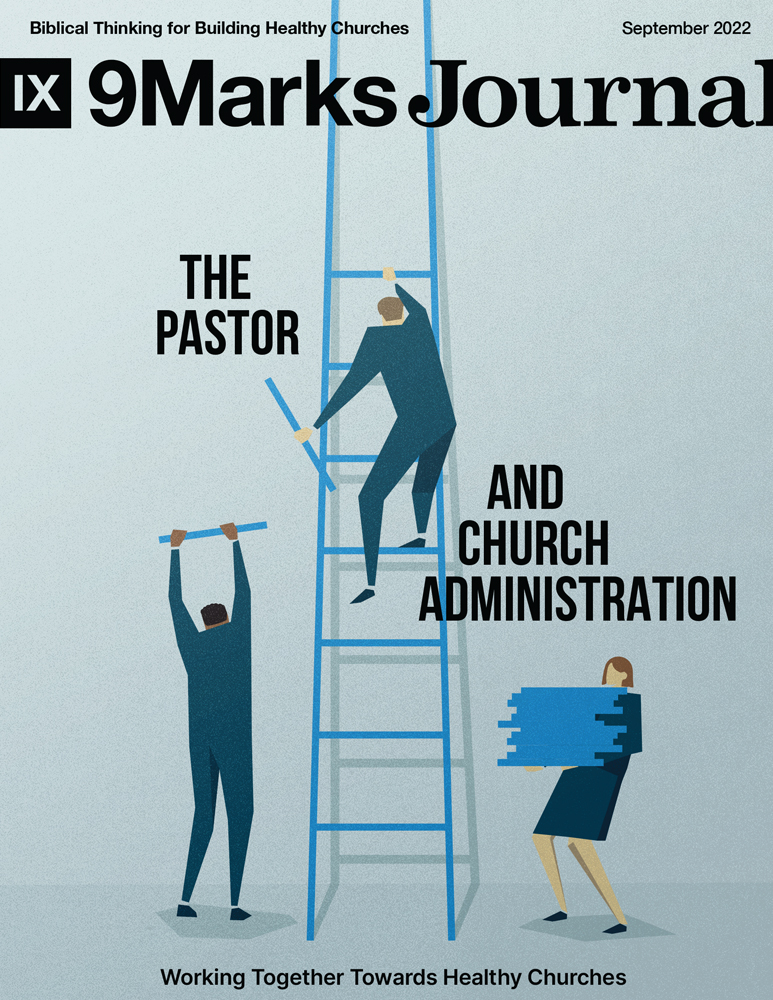
Pastors and deacons build up the body of Christ by caring for the staffing structures, pay policies, and building budgets.
Go to Journal →
“All Scripture is breathed out by God and profitable for teaching, for reproof, for correction, and for training in righteousness,...

The Lord has entrusted great wealth to Christians in the developed West. We must steward this money well.

Good administration and good administrators are a gift from God. Don’t neglect these gifts just because they seem boring or nerdy.

In Planting by Pastoring, author Nathan Knight challenges our view of church planting and centers the goal of pastoral ministry on a basic biblical foundation: a church plant is in fact a church, and a planter is in fact a pastor.
As churches rapidly expand, Christians risk viewing the church with an entrepreneurial mindset. Church planters can be tempted to fixate on gaining numbers and achieving financial stability as their only metrics for success. They fail to focus on lifting up Christ’s people within the church.

What is a deacon? What does a deacon do? In this second 9Marks Book Club, Jonathan Leeman and Matt Smethurst discuss the important topic of deacons in a local church. Buy the book here: https://9marks.myshopify.com/products…