

A Decent and Orderly Case for Raising Hands in Worship
December 5, 2025
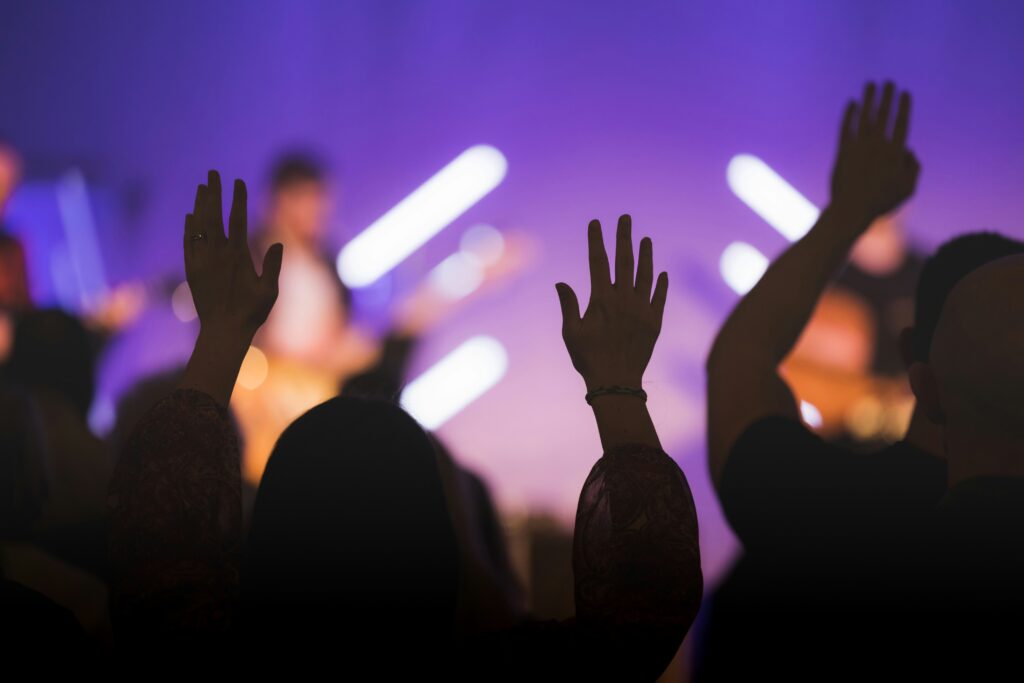
December 5, 2025
For many Christians, particularly those of us shaped by Reformed churches, physical expressiveness in worship can feel foreign, awkward, or even concerning. We are rightly cautious about emotionalism. We don’t want distractions in the gathered assembly, and we certainly don’t want to draw attention to ourselves rather than Christ.
Yet I think Scripture suggests that God wants more for us than internal, invisible worship. He created us as embodied creatures, and he means for our whole selves (not just our minds and hearts) to be engaged in his praise. The question is not whether our emotions should lead our worship (they should not), but whether God’s Word commends appropriate physical expressions of worship when we gather as his people.
Before considering Scripture on this question, consider your everyday life. When your team scores a last-second touchdown to win the game, you don’t whisper, “That was great.” You jump. You shout. You high-five. When sorrow settles on your soul, doesn’t your body show it? Your shoulders fall. Your eyes droop. Your hands wring. When you feel deep affection for a loved one, don’t you use your body—a hug, a kiss, a back scratch—to display your affection?
It’s self-evidently true that we are not disembodied brains; we are embodied souls. Emotions don’t merely live inside us; they manifest through us. If that’s true in everyday life, why should worship, the most significant expression of the heart, be any different? Therefore, it makes sense that we find consistent commendation of physical expressiveness in worship in the Bible.
A careful reader of the Scriptures will find that the Bible never argues for physical expressiveness in worship. It simply assumes and commands it.
Paul echoes this pattern when he instructs believers to pray “lifting holy hands” (1 Tim. 2:8). Physical expressiveness in worship is not charismatic chaos; it’s the biblical vision of praise.
Scripture commends and commands various physical expressions of worship, from bended knees (Ps. 95:6) to dancing feet (Ps. 149:3) to clapping hands (Ps. 47:1), but for this article, I’d simply like to focus on one: the raising of hands.
If God commands his people to raise their hands to him in praise (Ps. 134:2, 1 Tim. 2:8), we should assume that there is a good reason for doing so. Some might assume that hand raising is simply a cultural expression of praise, but a deeper analysis of the practice will reveal a theologically loaded physical expression.
In Scripture, our hands can either represent our righteousness or our corruption:
Do you see? Hands can shed innocent blood (Gen. 4) or heal (Matt. 8:3). They can grasp in greed or give in generosity. The hands, in other words, reveal the heart. Therefore, when we lift holy hands in worship, we’re not merely expressing ourselves; we’re displaying the purity of our hearts (or lack thereof) before God.
Of course, Scripture also warns against empty displays of worship (Matt. 6:1–6), so we must say two things at once:
What’s the solution? We begin with sincerity before the Lord. The question is not first, “How do my physical expressions affect those around me for good or ill?” but “Am I doing this in sincerity before God?” If the answer is yes, then we consider the second question: Does this edify others?
This is one of the main principles prescribed by the New Testament to regulate our worship. After we’ve asked all the right questions about our acts being acceptable to the Lord, we must ask about edifying the saints. Here’s how Paul says it in 1 Corinthians 14:26: “Let all things be done for building up.”
So when you raise your hands or drop to your knees, you should be asking yourself in this order:
That second question isn’t always easy to answer because contexts vary widely across different churches and denominations. For example, if you were worshipping with brothers and sisters in many African churches, you would very likely see joyful dancing unto the Lord. In that context, such physical expressions of worship wouldn’t distract but would edify.
But if you were to break out in dance during a hymn in a quiet Reformed Baptist congregation in the suburbs of Chicago, it is far more likely that you’d distract everyone there rather than build them up. Remember, love considers context. Love thinks not only of what is permissible, but of what is helpful (1 Cor. 10:23).
As in all areas of the Christian life, the question of physical expressiveness in worship requires wisdom and discernment. In that spirit, I encourage you to consider implementing one of the simplest and non-threatening physical expressions of worship commended by Scripture: the humble raising of holy hands. It’s a low-risk, high-reward gesture of praise.
Perhaps any idea of physical expressiveness in worship intimidates you. You feel like you’re just not built to use your body in worship. Even hand-raising feels out of the question. You’d much prefer hands-in-pocket praise. If that’s you, you might be wondering how much we ought to factor in personality to the equation of physical expressiveness in worship.
Some Christians are more like Hank Hill (hands in pockets) than King David (dancing in the streets). That’s okay. Scripture doesn’t demand uniformity in physical expressiveness, but it does demand charity toward others. Don’t judge the brother who raises his hands, and don’t judge the sister who doesn’t. As Paul is careful to remind us, “Who are you to pass judgment on the servant of another?” (Rom. 14:4)
Remember, even when considering the conscience, context matters. If you visit a more expressive church, joining them may be the most loving and edifying thing to do. If you visit a more reserved congregation, restraint may better serve unity. We don’t gather with the saints to draw attention to ourselves; we gather to worship the Lord and build up the body of Christ. Sometimes love expresses itself fully; sometimes love restrains itself for the sake of others. Both honor Christ.
Brothers and sisters, many of us have wisely guarded against emotionalism and charismatic chaos in worship. This is good and right. But let us be careful that in resisting excess, we don’t neglect what Scripture encourages, and even commands.
If, as you study God’s Word, you are persuaded that certain physical expressions of worship are fitting acts of praise, then practice them humbly, unto the Lord, and for the edification of the body. And if not, worship sincerely as your conscience is persuaded by a careful reading of Scripture. The Lord is patient with his people as we grow.
God’s Word tells us that one day we will worship the Lord in glorified bodies without hesitation or distraction: perfectly, joyfully, and bodily (Rev. 4:10; 7:9–11; 19:1–6). Until that day, we should seek to bring our present worship increasingly in line with God’s Word. We do this carefully, humbly, and according to a conscience shaped by Scripture.
May the Lord help us to worship him now, in these frail bodies, in a manner that anticipates the fullness of that future day.

There are kinds of worship that God doesn’t approve of and our own instincts on how to worship him are often wrong.

9Marks asked a couple of pastors who have thought a lot about corporate worship for book recommendations on the subject.

Where did the idea of going to church originate? Some of the typical culprits suggested are Constantine, American business models, old people, or pastors desperately in need of jobs. But whose idea is it, really?

What is a deacon? What does a deacon do? In this second 9Marks Book Club, Jonathan Leeman and Matt Smethurst discuss the important topic of deacons in a local church. Buy the book here: https://9marks.myshopify.com/products…

Mark Dever, Jonathan Leeman, and friends discuss Revival vs. Revivalism, a conversation about two different ways of doing ministry today.

Matt Rhodes explains that modern missionaries’ emphasis on minimal training and quick conversions can result in slipshod evangelism that harms the communities they intend to help.
