

Don’t Take the Supper at Youth Camp or Get Baptized in the Jordan

October 6, 2025


October 6, 2025
Picture a scenario, familiar to many, where a Christian approaches you after the service, asking if her discipleship group can take the Lord’s Supper together when they meet every other week at a coffee shop. Her reason? She serves in the children’s ministry on many first Sundays when the church observes communion. In reply, you express your reservations, “Baptism and the Lord’s Supper belong to the church.” “Right! And we are all members of the ‘big-C’ Church,” she responds. Her intention is heartfelt, and her inquiry is earnest. At this point, you may intuitively think her request doesn’t seem right.
But would you be able to explain why from Scripture?
In what follows, I aim to argue that the ordinances belong to the local church. As such, their most fitting location is in the local church alone. I will demonstrate this by considering what the ordinances are and how they feature in the Bible. Then I will consider what the universal church is and how we identify it in space and time. Finally, I will consider a few implications which follow from this account of the ordinances and conclude the argument.
Baptism is an act of obedience for every believer. Jesus requires his followers to be baptized (Matt. 28:19). It is the first command a new Christian must obey. Paul assumed every Christian he wrote to had already been baptized (Rom. 6:3–4). So close is the association between baptism and becoming a Christian, Peter and Luke can use one to refer to the other (Acts 2:38, 1 Pet. 3:21).11 .When portraying the process of publicly becoming a Christian, the book of Acts exemplifies the close connection between baptism, repentance, faith, forgiveness of sins, and the gift of the Spirit, specifically by using each as a metonymy for the whole complex of Christian conversion. Scripture references here would be too numerous to list, so see Robert Stein, “Baptism in Luke-Acts” in Believer’s Baptism: Sign of the New Covenant in Christ, 35-66.
Baptism is also the way faith goes public.22 .For a fuller treatment of this theme, see Bobby Jamieson, Going Public: Why Baptism Is Required for Church Membership. People are commanded to come to Christ both inwardly (Matt. 11:28) and outwardly (Acts 2:38). In fact, the “outward declares the inward.”33 .In other words, the visible attests to the invisible. It can be tempting today to overemphasize the internal reality at the expense of the external act, yet the Bible is not hesitant to enjoin both upon us. For more on this, see Bobby Jamieson, Going Public: Why Baptism Is Required for Church Membership, 11. In other words, becoming a Christian is always a personal act, but never a private one (cf. Matt. 10:32–33). Jesus wants us to repent, believe, and be immersed in water. He has not only identified with our humanity, but also set an example himself in being baptized (Matt. 3:13–17). Like our Lord, we should be baptized. In the New Testament, baptism is the way a person identifies with, commits to, and is marked off by Jesus (cf. Rom. 6:1–4; 1 Cor. 12:12–13; Gal. 3:26–27; Col. 2:11–12). There simply is no other way to profess faith, identify with Jesus as Savior (Gal. 3:26–27),44 .Baptism is not required for salvation. No doubt, the thief on the cross went to heaven as dry as the asphalt on a hot summer day in Fort Worth (cf. Luke 23:39–43). Furthermore, Paul is glad to have not baptized many of the Corinthian Christians; in fact, he’s uncertain who he baptized! (1 Cor. 1:13–17). commit to following Jesus as Lord (1 Pet. 3:21),55 .Bobby Jamieson calls baptism “a wordless promise or oath.” For, in baptism, we commit to follow Jesus for the rest of our days. For this reason, churches often use verbal vows before the baptism occurs (e.g., “Do you come to be baptized today to declare your trust in the finished work of Jesus Christ? Is it your desire to follow him for the rest of your days?”). and be marked off from the world (Rom. 6:1–4).66 .In and of itself, baptism does not create or affect anything. Yet, when paired with the preaching of the Word and the faith of the recipient, the ordinary act of immersion in water becomes a sign and seal of the New Covenant. Like circumcision, baptism marks a person as a visible member of the covenant (Col. 2:11–12). With Jesus’s own authority, a church declares through baptism that they discern the baptized person is a disciple, having received the internal circumcision of the heart.
As such, baptism joins one Christian to a group of other Christians in a church relation. It signifies that one Christian belongs to Christ’s body, the church. In baptism, a local church affirms and identifies a disciple as belonging to Christ, as one of his followers. Thus, baptism is a church’s act.77 .For more on this see, Bobby Jamieson, Understanding Baptism. As much as baptism is an act of an individual, it is also an act of a church. Through baptism, a church affirms and agrees to oversee a believer’s discipleship to Christ. When a baptism takes place, the church effectively says, “This one is with Jesus, like the rest of us.”88 .As such, as Fred Malone argues in The Baptism of Disciples Alone, disciples are the only appropriate recipients of baptism. Neither Jesus nor the apostles have given any warrant for churches to baptize without first discerning visible fruit of repentance and faith (cf. Acts 2:38). On this point, it’s important to recognize that Jesus has bound the church’s declarative authority to baptism. Matthew 28:19 must be read in the context of Matthew 16:13–20 and 18:15–20. Jesus has given one institution on earth unique authority to speak on his behalf, and he tied the church’s use of the “keys of the kingdom” to baptism.99 .And the Lord’s Supper, but we consider that more below. Therefore, baptism should be done in the context of a local church because it is ordained by Jesus for his gathered people.
While baptism joins one to many, the Lord’s Supper makes many into one. Our Lord Jesus instituted this ordinance when he observed the Passover meal with his disciples and said, “Do this in remembrance of me” (Luke 22:14–20; cf. 1 Cor. 11:23–25). The Lord’s Supper is the fulfillment of the Passover, like shadow to substance.1010 .In Egypt, the LORD commanded that a spotless lamb be sacrificed in the place of his people (Exod. 12:1–6). In this way, the LORD would pass over his people, saving them from sure destruction (Exod. 12:12–13). Because blood had been shed in their place, their firstborns would not die like those of the Egyptians. In a greater way than the Passover, Jesus’s blood was shed for his people. He drank the cup of the wrath of God, suffering death on the cross so that we could be spared. The Supper signifies this relationship. For Jesus said, “This is my body, which is given for you,” and “this cup that is poured out for you is the new covenant in my blood” (Luke 22:19–20). Thus, the Lord’s Supper signifies the blood of Christ which covers his people and the bond between Christians which he creates.
The Lord’s Supper is the corporate proclamation of our common, crucified Christ through eating and drinking the elements of bread and wine. The apostle Paul speaks in exactly this way: “Because there is one bread, we who are many are one body, for we all partake of the one bread” (1 Cor. 10:17). This is a foundational text for understanding the Supper.1111 .Bobby Jamieson, Understanding the Lord’s Supper, 30-32. In the Supper, we re-commit ourselves to Christ and his church in mutual love, affirmation, and oversight. The Supper makes unrelated people into a covenant family. As such, the Lord’s Supper should be taken corporately by a church when they come together as a church (cf. 1 Cor. 11:17, 18, 33–34). In fact, Paul went so far as to deny that the Corinthians were taking the Lord’s Supper at all because they did not wait until all were together (1 Cor. 11:20)! We could argue, with no gathered church, there is no Lord’s Supper.
The universal church includes all those redeemed by Christ—all Christians in all places across all times. That means the universal incorporates the sum of the regenerate members of all true local churches. Yet, until the eschaton, the universal church cannot be seen. It is spiritual and therefore invisible. Our knowledge and experience of the universal church are mediated through the judgment of local churches. In short, local churches particularize the universal church. If local churches use the authority given by Jesus in the keys of the kingdom, then the ordinances represent the visible outworking of that authority. In the ordinances, the universal church becomes visible in local churches. The ordinances make and mark the local church as a church. The ordinances are the connection in space and time between local churches and the universal church.
A local church is a group of Christians who gather regularly in obedience to God’s Word as it is preached, and who are marked out from the world by the ordinances of baptism and the Lord’s Supper. Thus, in one important sense, it takes a church to know a Christian. The Christian life is church-centered, and the ordinances give shape and accountability to the Christian life as a life together in corporate, covenant community. How? Because they identify which Christians have regular, biblical obligations to one another. One analogy may help to illustrate the point. Do pastors have the same obligation to oversee and care for the souls of all Christians everywhere, or to one local church (Heb. 13:17)? In the same way, the ordinances mark out which Christians belong to a particular local church.
A few implications follow from this understanding of a local church as created by the ordinances.
First, anything that disconnects the ordinances from church membership confuses the meaning of Christ’s commands and the shape of the Christian life. Baptisms at summer camp, on a mission trip, or in the family swimming pool obfuscate the reality that the ordinances belong to the local church.
Additionally, though it is popular today to signify conversion by raising a hand, walking an aisle, or praying a prayer, the biblical way to publicly identify yourself as a Christian is through baptism. Since baptism is an ordinance of the church, not the family, the practice of fathers baptizing children—especially when the father is not a pastor or the normal person who baptizes—may actually communicate the wrong things about salvation and the Christian life.
A similar challenge faces those who attempt to observe the Lord’s Supper at a wedding or in a small group. For the ordinances to be properly understood, the whole church must be genuinely invited to gather for the occasion. The ordinances draw a line around the group of Christians who gather regularly, demarcating them as a local church. Since the ordinances of baptism and the Lord’s Supper constitute a group of Christians as a local church, the ordinances belong to the local church as a church. Simply put, we call “church membership” what the ordinances create; it’s a theological term for how the ordinances constitute the local church.
Strict security was part and parcel of my first paid job. Every member of the company was issued an ID badge. This badge identified an employee as a part of the company. It allowed access into the building. It certified an individual as an official company representative. These ID badges were badges of belonging. Everyone who belonged to the company had the badge. Though I was an employee before I had the official badge, no one else at the company could know I belonged until I had this public identity marker.
In a similar way, the two Christian ordinances of baptism and the Lord’s Supper are badges of belonging to the local church. Participating in baptism and the Lord’s Supper does not make someone a Christian. Yet, these badges of belonging create a new social or churchly reality. That is, the ordinances mark out a group of Christians from the world, making them into a local church together. They are effective signs that create the common reality to which they point.
In baptism, one Christian is added to many other Christians. In the Lord’s Supper, many Christians are bound together as one local church. For this reason, they belong to the local church alone.
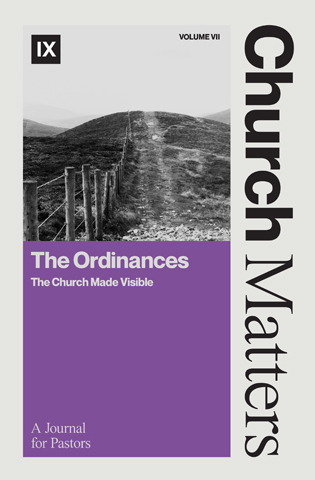
Within the sacred gathering of the local church, Jesus offers the chance to see with your eyes and taste with your mouths what he has done for you all.
Go to Journal →
If you can answer four questions affirmatively then I think you’re looking at a true baptism.

Just as your church (hopefully) does not allow just anyone to preach the Word, so also should your church think carefully about who administers the ordinances.

To help Christians follow a conscience bound by Scripture is not pedantic, but wise.

In Planting by Pastoring, author Nathan Knight challenges our view of church planting and centers the goal of pastoral ministry on a basic biblical foundation: a church plant is in fact a church, and a planter is in fact a pastor.

As churches rapidly expand, Christians risk viewing the church with an entrepreneurial mindset. Church planters can be tempted to fixate on gaining numbers and achieving financial stability as their only metrics for success. They fail to focus on lifting up Christ’s people within the church.

What is a deacon? What does a deacon do? In this second 9Marks Book Club, Jonathan Leeman and Matt Smethurst discuss the important topic of deacons in a local church. Buy the book here: https://9marks.myshopify.com/products…