

How God Prepared Our Church for 9/11 Through Sermon Planning

September 11, 2026


September 11, 2026
On Tuesday, September 11, 2001, the United States suffered the deadliest foreign attack on U.S. soil in American history. That morning two hijacked planes a little more than fifteen minutes apart flew into the Twin Towers in New York City. Shortly thereafter, another plane crashed into the west side of the Pentagon in Washington, D.C. Finally, a fourth plane, which is believed to have been heading for another D.C. target, crash-landed in a field in Shanksville, Pennsylvania, after passengers fought back against the plane’s four hijackers.
In total, 2997 people lost their lives. Devastating is not strong enough of a word to describe the impact of those attacks.
Twenty-five years on, and it’s still common to hear people recall where they were when they first learned of the attacks on 9/11. If you were pastoring at that time, amid the shock and sadness you undoubtedly felt, you were probably also wondering what you were going to say on that upcoming Sunday, September 16. Knowing that your people would come questioning and grieving and fearing and feeling angry, you likely tried to speak to them at their point of need, maybe even doing so multiple times throughout the service, from the transitions in the service, to the prayers you prayed, to the songs you sang. You may, like our pastor, Mark, have even inserted a time in the service where you offered a theological and pastoral word in light of the terrible loss. You can read or listen to his remarks here.11 .Mark Dever, “A Word on September 11, 2001” (sermon, Capitol Hill Baptist Church, September 16, 2001), https://www.9marks.org/article/mark-devers-remarks-the-sunday-after-9-11.
But what about the sermon? Well, if I polled the pastors I know, I would guess a fair number of them ended up changing their text or topic. And, depending on what they had planned, I am sure their decision to pivot was best for their people. This underlines the fact that, sometimes, pastors have to respond quickly to care for the sheep among them. Praise the Lord that a prayer for wisdom is one he promises to answer affirmatively (Jas. 1:5).
In the case of our church on Capitol Hill, it seems the Lord was providentially working for our good through the service planning of our pastors, which had been done months in advance. We were in the middle of a two-part series in Habakkuk entitled “When Bad Things Happen,”22 .See the published sermon card with our September through December schedule below. and Bert Daniel, a guest preacher and former intern, preached a message titled “Confidence” from Habakkuk 3 on that Sunday after the attacks.33 .You can listen to his sermon here: https://www.capitolhillbaptist.org/sermon/confidence/. Take a look at the original sermon card here:
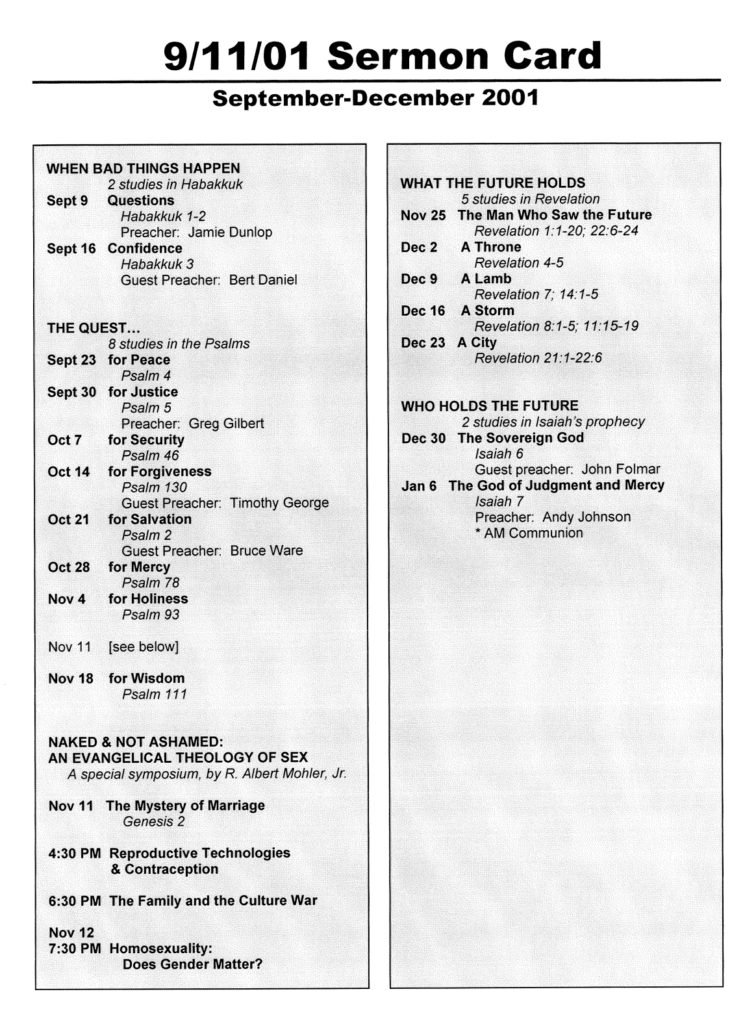
And did you notice the sermon titles that followed 9/16? “A Quest for Peace.” “…for Justice,” “…for Security,” and “…for Forgiveness.” Who but God could have planned that! It’s like he was walking the congregation through stages of grief.
This particular providence is a reminder that the Lord can work his wisdom into our plans long before we realize how great our need will be or when it will arrive. Those brothers who made the sermon schedule certainly didn’t know how needy our church would be on September 16. Yet they asked the Lord for help and wisdom, and he provided it in an amazing way.
Maybe you feel your own need for help and wisdom even now. If so, take heart: God has invited all his children to come to him with a confidence born out of the sure knowledge that through Christ, our great high priest, we will receive mercy and grace in our time of need (Heb. 4:16).
For pastors specifically, you may not know precisely what your people need right now, or what they’ll need tomorrow or next year or ten years from now. But what you can know for sure is that as much as you want and plan for their good, the Lord their God desires and plans for it even more. Let this comfort you the next time you go to him on their behalf. Your Father, and theirs, knows and will give all that they need.