

How Much of My Suffering Should I Share with My People?

August 24, 2026


August 24, 2026
Abstract: Garrett Kell offers nine questions to help pastors discern how much of their suffering to share with their church. Kell’s questions are based on biblical principles as well as his experience of walking through intense suffering in his own family. While every pastor and every church are different, pastors should consider how sharing might affect their wife, their children, and their church’s focus on Jesus Christ.
As pastors we live in plain view of God’s people. God designs it this way so that the flock can observe and emulate our faith (Heb. 13:7; 1 Pet. 5:3). Our people need to see how we practice what we preach in every area of life—including how we suffer.
The past few years have been a uniquely trying season for my family and me. We’ve endured numerous hardships that have changed nearly everything about our lives. In December 2023, my oldest daughter had a seizure that lasted twenty-six hours and forced her onto life support. That was followed by a six-month hospital stay. This coincided with my mother’s brutal battle with pancreatic cancer. Other trials during this time have only been shared with a small circle of friends.
Suffering drains us physically, emotionally, and spiritually, and we don’t feel like we have the strength to keep going, let alone help others keep going. We are tempted to question things about God that we never thought we would. Sharing our weaknesses can bring shame, guilt, and anxiety over how people might respond.
Yet part of leadership is modeling how to trust God in suffering. As you consider how to steward your own afflictions, you’ll be confronted with the question: How much of my suffering should I share with my people? No two pastors or church situations are identical (Prov. 14:10), so you’ll need the Lord’s wisdom, which he gladly supplies (Jas. 1:5; Prov. 3:5–6). I want to offer nine questions, however, to help you discern how much of your suffering to share and how to do it wisely.
Scripture shows us that Jonathan “strengthened David’s hand in God” when David was on the brink of despair (1 Sam. 23:16). We all need Jonathans in our lives. Who are the brothers who were born for your day of adversity? Who can you call, no matter what time it is, and pour out your heart to? Who can you weep with and confess your doubts, fears, and the unraveling you’re experiencing? To survive in life and ministry, you must have a few close friends.
Open your heart to these trusted brothers and hold nothing back. Allow them to bear your burden. Ask them for wisdom about how much and when to share. Since grief can cloud our ability to see reality rightly, we need faithful counselors to help us remain steady under the Lord’s mighty hand.
Your fellow elders are your pastors, which means God has called them to care for your soul. Hopefully, some of them are those trusted friends I just mentioned. But even if not, they need to know what you’re going through so they can offer prayer and encouragement. They also need to be able to speak into how much you share with the rest of the church, which means they need to know how your suffering is impacting your family. My elders loved me remarkably well in our season of suffering.
But what if your elders aren’t as helpful, or if they’re actually the source of your sorrow? That’s tragic, but not uncommon. If you can trust at least one or two of them, start there. If you don’t have that level of trust with any of your fellow pastors, find a pastor friend outside your church who can offer unbiased counsel and assist in any needed mediation.
When you suffer, your wife suffers as well. God calls you to live with her in an understanding way (1 Pet. 3:7), and caring for her is part of what qualifies you to shepherd God’s flock. Stay attentive, then, and listen to her. If you have to choose between using your limited strength to care for your church or for your wife, choose your wife. The church can get another pastor, but your wife can’t get another husband. And remember that the two of you will likely not grieve in the same way. My wife and I learned this over time, and it brought tension and additional trials. But God will help you, even as he’s helping us.
One practical way to care for your wife is to make sure that she approves of whatever you share with the church. You may need to help her understand why you think you should share something, or you may need to be humble enough to follow her counsel. Pray about it together and ask God to give you unity in your decision. If the two of you are struggling in any way, involve other elders and a sister she feels comfortable with. God will help you. Don’t give up.
If the suffering includes your children, be careful not to dishonor them in what you share. If possible, make sure you have their permission before sharing something that involves or reflects on them. In our case, Eden was in a coma, and we did not know if she would live. Once she eventually regained consciousness, we made sure that any posts or updates were approved by her. We desired to honor her, not exploit her. Being a pastor’s child is hard enough as it is.
There are, of course, many unique situations. Maybe your child is handicapped, neurodivergent, or especially rebellious. In such cases, guard them (as much as possible) from becoming a public spectacle or from being unnecessarily scrutinized by the flock.
Timing matters. Some things need to be shared immediately. Tragedies, for instance, tend to force our hand. In such cases, either you or another elder can share with the church what has happened. This should be followed by instructions for the church on how to get updates and provide help.
Allowing for some time to pass may be best if you’re unsure about when to share. I’ve found that God used my (more immediate) raw testimony as well as my more thought-out version in useful ways, though quite differently. Ask those closest to you for counsel on the timing aspect of sharing.
I’m likely to share most anything interpersonally if I feel like it might be beneficial. If, for example, someone shares about their own suffering, I might feel obliged to share about ours. Or it could be something as simple as someone asking, “How are you doing?” I’ve learned to be honest in my response by saying something like, “It’s been a hard season, but God is holding us together,” or, “We’re stable, so you can keep us in your prayers.” Those aren’t flippant words; they’re moments of vulnerability that God can use to help a fellow saint support you in your suffering.
God’s people not only need to hear you preach, but they also need to see that you live what you preach. That you don’t just know your sermons but need them. Don’t underestimate how much they are blessed by seeing God sustain you in suffering and weakness. It can help cultivate in them humility, vulnerability, and hopeful authenticity.
On several occasions, I received texts, emails, or personal words of encouragement about how people had been helped by watching me trust God during my trials. One Sunday afternoon, someone texted with a picture of my wife and me standing next to my dying mother and our fresh-out-of-the-hospital daughter. The message said, “Pastor, seeing you and Carrie trust God in this horrible season has helped my faith grow. Thank you.” They’d heard me tell them thousands of times that Jesus was worth whatever it costs to follow him, and now they were seeing me being forced to live it.
If a pastor never shares the burdens of his heart or his struggles, his preaching and pastoring can seem robotic or like a mere academic exercise. Carefully opening the windows on your life so people can see the messiness of your faith can help others open up and become more vulnerable.
Sometimes pastors share about their personal life in a way that tends to dominate the attention of the church. The focus shifts from Christ to the pastor and his family. Certainly, if the pastor is enduring a tragedy, there should be a concerted focus on praying for and supporting him and his family. But if the pastor shares too often or if he references his situation repeatedly in his sermons, it can distract from the point of the text. I tend to share more openly than most pastors, which means I have to be very careful here. Unfortunately, there have been times where I’ve probably crossed the line.
One pastor friend who battles with chronic pain said, “I’m careful to share sporadically but consistently. Sharing once a year about my disability and depression is only once every 52 weeks (not a lot); but over fifteen years, that’s fifteen times vulnerably sharing about my physical and emotional pain.” This approach gives people a glimpse into their pastor’s life and helps them know how to pray for him. Instead of dominating the church’s attention, the pastor’s faith encourages members in their own suffering.
The most sensitive information should likely only be shared at a members’ meeting. Evening or midweek prayer services also offer an opportunity to relay updates and receive prayer in a more intimate setting. Several years ago, one of our pastors shared at an evening service about how he and his wife had endured a decade-long struggle with infertility. His tender tears and trust in God stirred the flock to express their love for this couple and intercede on their behalf.
A Sunday morning service offers the broadest exposure, but prayers should not become veiled announcements. It’s best to provide an update about the situation first and then pray about it. If you share something in your sermon, don’t let it distract from the preaching of God’s Word.
Sharing comes with a risk. We don’t know how our people will respond, as every pastor and every church are unique. Some will weep with you, pray for you, and love you well. Others will care somewhat and possibly pray, but they see you as more of a spiritual provider who should be above his circumstances. Still others will care but (unintentionally) respond in unhelpful ways, like trying to cast out a demon, saying things to your wife that upset her, or “prophesying God’s message over you.” Some people will assume that the suffering is your fault and gossip about it. And some may see it as an opportunity to gain control of the church, or even to force you out. Typically, the more mature your church, the more open you can be.
Regardless of how your people respond, and even if you make mistakes along the way, keep your eyes on God, who promises to work all things for your good, which includes your suffering (Rom. 8:28). He wastes nothing. As you allow your people to see your hope being refined, you can trust that God will refine theirs too.
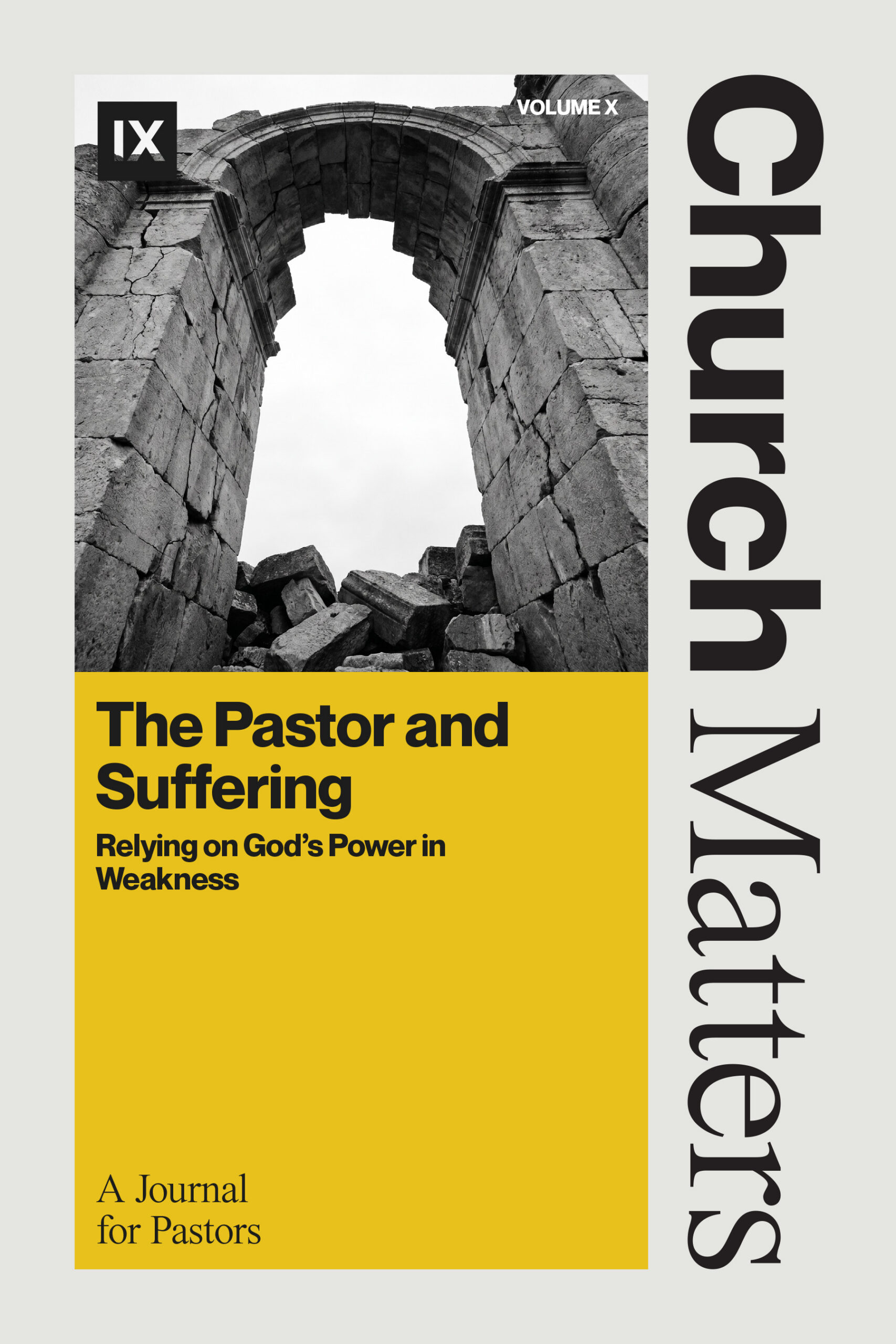
No pastor is immune from suffering. Whether it's cancer, depression, grief, or persecution, pastors face the same kinds of trials as their people. Not to mention the difficulties that arise from the ministry itself. But how can pastors strengthen God's people amid their own suffering?
Go to Journal →