

Marriage: What God Joins Together Is Good for the World
February 4, 2026
February 4, 2026
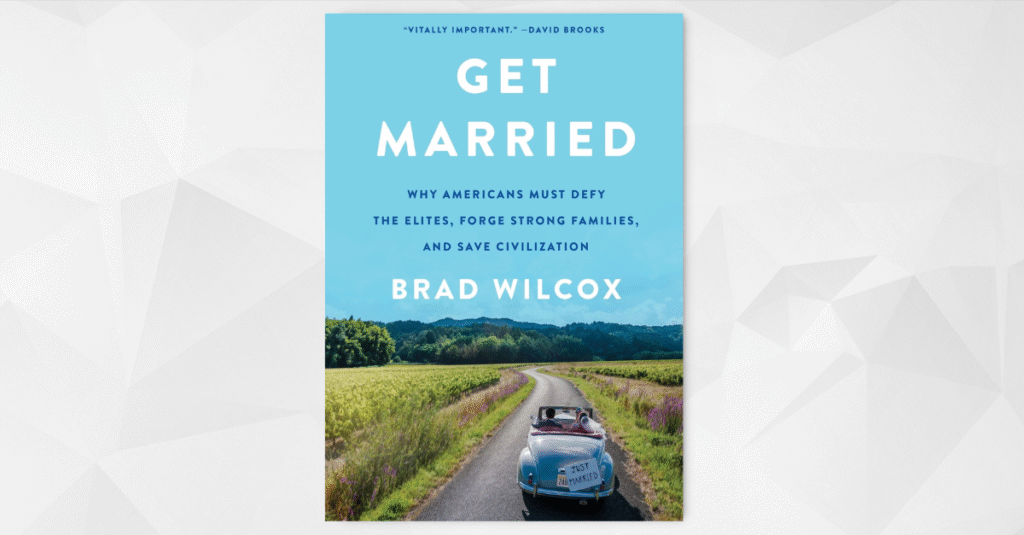
Brad Wilcox, Get Married: Why Americans Must Defy the Elites, Forge Strong Families, and Save Civilization. Broadside Books, 2024. 320 pp.
Few issues command the attention of Americans today like our sexual and marital unions. Daily news reports—let alone the tidings percolating from the pews—attest to our disordered ways. The costs of family dysfunction and personal alienation are overwhelming and incalculable.
An article in Harper’s Magazine highlighted individuals and couples morally committed to not having children, collectively known as the “antinatalist” movement. In a world of hardship and suffering, into which children by definition did not consent to enter, and one which will soon be destroyed by climate change and other products of human rapaciousness, antinatalists argue it is good and right to cease human procreation and persuade others to do likewise. Meanwhile, the reproduction rate in the U.S. has fallen to 1.6 per woman, well short of the replacement rate of 2.1, but still ahead of many other putatively advanced nations.
If we cannot be bothered to reproduce, if non-existence seems preferable to the burdens, responsibilities, and givenness of life, perhaps we can at least find solace in happy marriages. After all, Hollywood and popular music have long allured us with the promise of romantic dinners, satisfying sex, and deep communion with our true love. But our sexual and mating economy today is a dark place, filled with loneliness, hurt, and cynicism. Increasingly, people are opting out.
Figures like Andrew Tate and movements like MGTOW (Men Going Their Own Way) urge millions of young men to avoid marriage; sure, have lots of sex with women, but always on your terms and at sufficient emotional distance, because marriage is a sucker’s bet to be eluded at all costs. In a feminized society, the marital deck is stacked against men, from relentlessly demanding women to punitive family courts, so self-protection and selective opt-outs make sense.
Involuntary celibates, or “incels,” likewise maintain an anti-woman rhetoric, often tinged with deep hostility toward the women they cannot get and the “Chads and Stacys” who rule the dating world. These “manosphere” manifestations are mirror images of various strands of feminism, which have long traded in similar pain, strategies, and dismissals toward men. Today’s dating world is fraught with normlessness, uncertainties, and mutual incomprehension and antagonism.
Some six decades into our massive social experiment with reordering sex and sexuality, gender, and marriage and family, the state of our marital unions doesn’t look much better. Around forty percent of first-time marriages now end in divorce, admittedly a decline over the past couple decades, but only because so many people do not get married, even when they are procreating. Some forty percent of American children are born out of wedlock today, an astounding figure with massively detrimental social costs for the children involved and for society at large. No wonder there is so much fear, wariness, and anger between the sexes today, especially young men and women.
Into this minefield steps Brad Wilcox with a straightforward message: get married and build strong families, defying the antenuptial and antinatalist messaging of our ruling elites. Wilcox, a sociologist and director of the National Marriage Project at the University of Virginia, has long studied marriage and family at the highly regarded Institute for Family Studies at UVA. In various academic and popular venues, Wilcox has written extensively on these topics. In Get Married, he aims to reach a popular audience with an accessible, academically grounded treatment of the heterosexual marital landscape today. In particular, Wilcox hopes to puncture several prevailing myths surrounding marriage, highlight its beneficial characteristics and which communities or groups are doing best in the marital realm, and challenge cultural elites to preach what they practice.
According to our leading lights, life is better “flying solo,” unencumbered by the demands and unrealistic expectations of lifelong monogamous marriage, as illustrated in countless films and bestsellers, such as Elizabeth Gilbert’s Eat, Pray, and Love (2006). But clear survey evidence that married people on balance are healthier and happier, along with our national loneliness epidemic, suggest otherwise. The “family diversity myth” claims it is love and money, not stable and enduring marriages, that create secure and successful families. The bonds of romantic love and the power of personal choice enable us to construct authentic and meaningful families that, while not necessarily permanent, are legitimate because they’re self-chosen and self-enhancing.
Until they’re not. Many decades of social scientific and family research attest that children fare much better with their biological father and mother except in the most dangerous situations. One indication: children are roughly seven times more likely to suffer physical and sexual abuse when stepparents or paramours are in their homes than with biological parents.
Finally, Wilcox tackles the “soulmate myth,” the central trope of countless rom-coms and online dating services. Expecting your spouse to fulfill your deepest longings, facilitate your growth into wholeness, and maintain your ongoing happiness, all while remaining suitably romantic and sexy, is a recipe for disillusionment. Or perhaps perpetually shifting illusions. At last count, Elizabeth Gilbert had dispensed with the Brazilian husband she met in Bali after ditching her stifling first marriage and going on a journey of personal renewal; proceeded to engage in several torrid love affairs, including with a dying female friend; and now sings the praises of singleness and non-maternity in her fifties, still seeking her one true soulmate.
Wilcox addresses several other misconceptions that muddy the marital waters stirred by our elites. Children do not make life miserable and marriages unhappy. In fact, in most cases they enhance the happiness of parents and strengthen marriages by eliciting mutual sacrifice and teamwork for the well-being of others and for goals that extend beyond the limited confines of the self.
What Wilcox calls “blank-slate feminism,” or “the idea that there is no fundamental difference between men and women,” underlies assertions that marital responsibilities and tasks should be evenly divided. But his inquiry into the actual lives of married couples, including those who support such views, suggests that in practice women want men to be the primary providers and protectors, while being attentive to them and their aspirations, and they want to be the principal caregivers for their children.
Not surprisingly, guarded protection of self-interest and personal needs does not promote marital health. Rather, a focus on “we before me” is critical in marriage, but our culture of expressive individualism and self-obsession makes this exceedingly difficult. Religions like Christianity that promote selflessness, sacrifice for the good of others, mutual forbearance, and forgiveness are an inestimable support of good marriages and a bulwark against a corrosive culture. Indeed, Wilcox finds that what he calls “masters of marriage”—those with tangibly higher rates of marital success—include people active in religious communities, social conservatives, communally minded Asian Americans, and what he calls “Strivers,” or upper-middle-class professionals who rigorously pursue socioeconomic and status enhancement for themselves and their children.
The outlier here is the Strivers. Whereas the other groups promote traditional marriage and family conceptions, often embedded within a framework of interdependent communal relations and bonds, the Strivers are secular progressives. They attend elite colleges, populate key urban centers of power and influence in their twenties and thirties, and then decamp to wealthy suburbs with highly rated schools once children arrive. And they seem to want nothing more than for their offspring to attend the same caliber of schools and have the same opportunities for advancement they had in an ever more frenetic, competitive landscape.
Wilcox directs his most incisive criticism to these Strivers, who “preach left and walk right.” That is, they promote and peddle the falsehoods that erode our marital and family culture, through positions of influence in government, academia, law, media, and corporations, but they follow and teach their children the success formula of finish school, get a job, get married, and have children, in that order. They attack the “bourgeois values” of the traditional family as racist and sexist, but they carefully enact them in their homes. Wilcox devotes lots of time to exposing the hypocrisy of professed liberationism. Even while they have gutted one of the few traditional sources of relative stability for the poor and working classes through the sexual revolution, no-fault divorce, economic globalism, and so much more, our ruling elite has maximized their own sexual, moral, and familial freedom of action. The despairing results are evident in small towns and urban wastelands throughout America, but they can be awfully hard to see from McLean, Palo Alto, and Princeton.
Or Charlottesville, for that matter, where the beautifully manicured lawns of President Jefferson’s university may well keep such unpleasantness at bay. But not so for Brad Wilcox, Catholic husband, father of seven children (five adopted), and undaunted scholar of the family. Wilcox has written an honest book that displays the manifold benefits of traditional marriage and family, and he has written a courageous book that challenges our elites to talk their walk, to proclaim what they actually practice for their own good and that of their children.
The Old Testament prophets had much to say about the oppression visited on the poor and suffering by the wealthy, both direct and indirect. Modern forms of oppression are no less insidious, and modern idols no less destructive. In the name of justice and human flourishing, let us seek to rebuild the norms, structures, and practices of enduring, healthy marriages and families.

When conduct in the home lags behind the conduct we commend, we’re falling into hypocrisy.
Tim Witmer’s book is timely; but it’s not social critique or theological treatise. It’s simple, practical, Christian wisdom, rooted in biblical truth and love.

Our context makes the Christian life of singleness all the more challenging, and the healthy pastoring of single people all the more urgent.