

Should Christians Feel Guilty for Being Patriotic?
February 23, 2026
February 23, 2026
Abstract: In his review of Dan Darling’s book In Defense of Christian Patriotism, Pastor Sean Demars concludes that Darling has made a persuasive biblical case for the idea that patriotism is a fitting expression of gratitude for Christians in light of the people and place to which God has assigned them. Christians can give thanks for their country despite its faults, even as they give their highest allegiance to Christ and his kingdom.
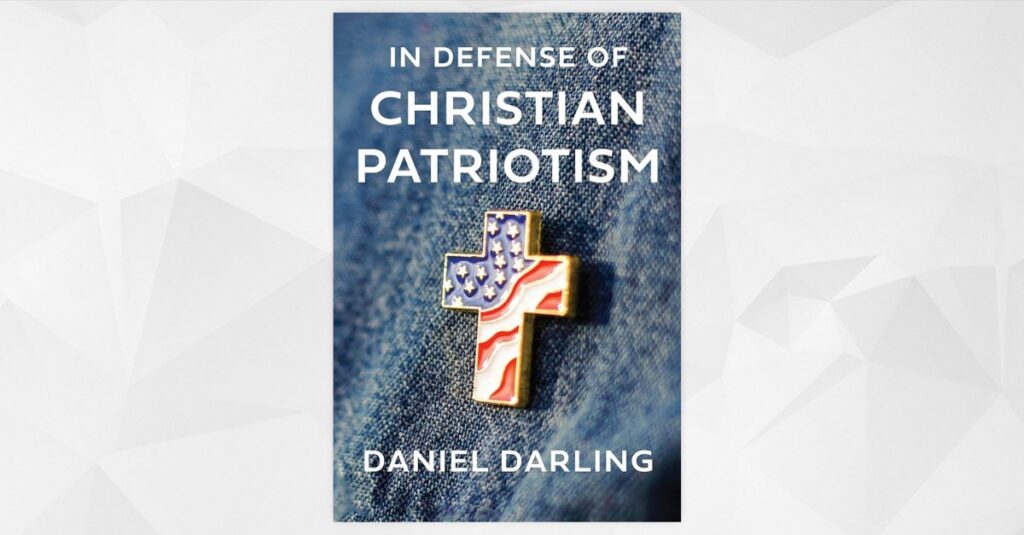
Daniel Darling, In Defense of Christian Patriotism. Broadside Books, 2025. 288 pp.
Talking about patriotism in church can feel like stepping on a landmine. Some Christians grew up with flags in the sanctuary and participated in “God and Country Sunday.” Others were warned about Christian nationalism and the dangers of idolizing one’s country. Many younger believers today simply feel uneasy saying anything positive about America at all. To put it simply, many faithful Christians are confused about patriotism.
Daniel Darling’s little book In Defense of Christian Patriotism aims to clear up some of that confusion. His main point is this: Christians can love their country without worshiping it. We shouldn’t embrace nationalism, but neither should we be embarrassed to show gratitude for the nation God has placed us in.
Right out of the gate, Darling puts his finger on something important: our culture is discipling us toward cynicism, not gratitude, and that spirit has crept into the church. Many Christians today feel like they need to apologize before they say anything good about America. But Darling reminds us that Scripture encourages gratitude wherever God has shown common grace. Patriotism isn’t about pretending our country has no flaws; rather, it’s about thanking God for the good he has given us, even in spite of those flaws.
Darling roots his reasoning in Christian worldview thinking. God created nations, he works through history, and he assigns all of us a place and a people to belong to. Loving your country, then, isn’t idolatry. It’s part of loving your neighbor.
Darling also spends time pushing back on the idea that faith has no place in public life. He shows that public expressions of faith aren’t a weird modern invention; they’re woven throughout American history. For example, past presidents prayed publicly, political leaders quoted Scripture, and churches shaped civic virtue. America was never a Christian nation, if by “Christian” we mean founded explicitly on the truths of the gospel, but neither was it designed to be a strictly secular nation in which expressions of faith were suppressed or discouraged. Furthermore, removing Christian influence doesn’t create neutrality; it just means another worldview fills the vacuum.
To be clear, Darling isn’t arguing for civil religion or baptizing a particular political party. He warns against confusing America with the kingdom of God, and he acknowledges that Christians have sometimes spoken unwisely and acted foolishly in political moments. Most importantly, he reminds us that our greatest witness comes through the local church, not from winning the culture wars.
I appreciate the tone of Darling’s book. It’s calm. It’s charitable. It refuses the extremes: “America is the hope of the world” or, on the other hand, “America is a dumpster fire and always has been.”
Will every reader agree with every line? Probably not. Some may want a stronger warning against patriotism because they think it tends toward idolatry. Others may wish that more time was spent critiquing secular progressivism. But at a time when many Christians feel lost between Ditch #1 (nationalism) and Ditch #2 (cynical resentment of America), Darling provides a good middle lane: Gratitude without worship. Discernment without disdain. Hope in Christ, not in the Constitution.
If you want a book that shouts or rants, this isn’t it. But if you want a wise, careful nudge to thank God for where he has placed you in the world, In Defense of Christian Patriotism is worth reading.