

The Preacher as Pastor and Mentor

March 30, 2026
March 30, 2026
Abstract: John Sarver reflects on Zack DiPrima’s book Charles Simeon: Parish Pastor by focusing on Simeon’s ministry of mentoring future pastors and missionaries. Simeon invested deeply in these young men, and the influence of his preaching and his love for Christ spread in his own day and in the centuries that have followed.
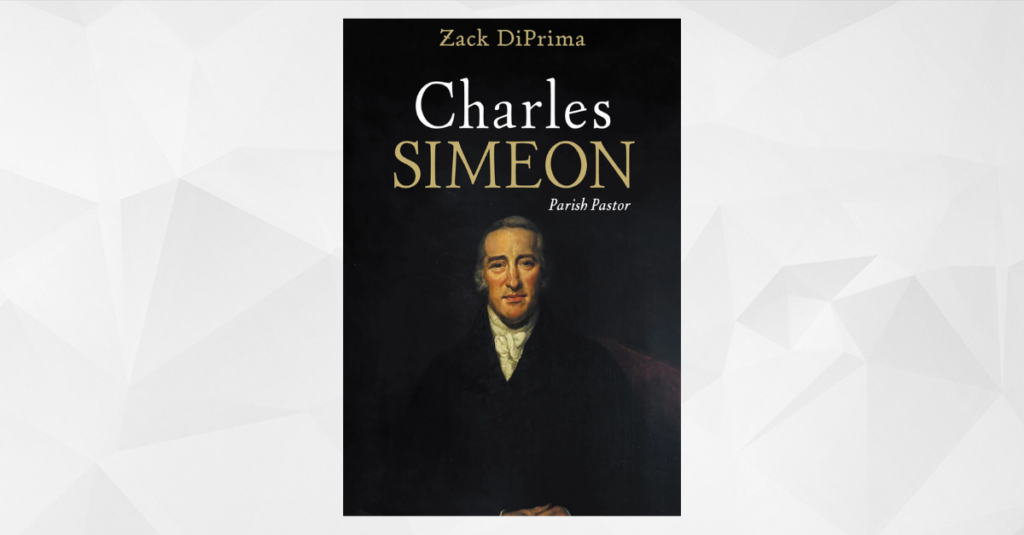
Zack DiPrima. Charles Simeon: Parish Pastor. Eugene, OR: Wipf & Stock, 2025.
If you’re reading this review on this site, you probably know Charles Simeon as a preacher—and for good reason. But what do you know about the man as a pastor?
Charles Simeon: Parish Pastor is Zack DiPrima’s treatment of this topic in a slightly modified form of his dissertation. While Simeon’s imposing preaching ministry and influence on Anglicanism in the eighteenth century are well documented, DiPrima’s research sheds light on the pastoral theology that undergirded his storied ministry (10). The book examines five aspects of the pastoral theology of the apostle of Cambridge: mentoring, churchmanship, personal piety, local parish ministry, and preaching (10).
DiPrima aims to give his readers a dead mentor. He writes as one whose spirituality has “been mostly shaped by evangelical Anglicans,” men such as Richard Sibbes, Charles Bridges, J.C. Ryle, and, of course, Charles Simeon. DiPrima also writes as one who would like to see a recovery of Simeon’s brand of ministry (ix), as we suffer from the lack of such models. “The broader evangelical movement today aches for a generation of pastors whose ministries are infused with the savor of Christ” (ix). I cannot help but agree. The pastors who rise to public prominence in our culture—and thus are the most accessible examples to follow—often do so because of their cantankerous extremity or pragmatic success.
Simeon, on the other hand, was not only zealous but warm, not only faithful but exceedingly fruitful, not only towering in his influence but committed to his local parish. He stands in contrast to the better-known evangelists of the eighteenth century who impacted the world by focusing on ministry outside their parishes. “By staying local and exemplifying an extraordinary commitment to ordinary ministry, he marshaled a multitude of zealous men ready to follow his model.” That is, “In order to reach people outside his parish, he molded pastors—and in order to train pastors, he cared for the people within his parish” (11). And the results were impressive: Simeon trained over 1100 ministers, placing pastors in a multitude of churches, sending missionaries, and inspiring the likes of Charles Bridges and John Stott. It’s Simeon’s commitment to simplicity and the ordinary means of grace that make his model of pastoring so magnetic and replicable.
Rather than offering a formal review of the book, I want to highlight a particular aspect of Simeon’s pastoral theology, his mentoring, in the hopes that it will inspire you to read the book and imitate the model and tenor of Simeon’s pastoral ministry.
Ministerial Mentor
Simeon understood that part of the pastor’s job is to replicate himself. Therefore, he generously gave his time to befriending and teaching young men at Cambridge. It’s important to situate Simeon in his own historical ecclesiological context to appreciate the significance of his approach.
Anglicanism was deeply hierarchical (30), yet Simeon, without eschewing his polity and tradition, treated all fellow Anglicans like peers. Of his curates (think lowly pastoral assistants) he remarked, “Not my curate” but “my brother.” Likewise, he gave the men he trained his time and affection, in part by hosting smaller gatherings—conversation parties and preaching cohorts. In the former, dozens of men (and some women) would pack into Simeon’s sitting room weekly to ask and learn about pastoral ministry. These “parties” were Socratic and uniquely “provided him an opportunity to address precise points of pastoral theology in an unhurried environment” (31). The preaching cohorts were smaller. “Simeon would offer a text for consideration and charged the men to produce a sermon outline for the text during the meeting” (31). Simeon would then provide feedback, allowing him to mold a generation of future preachers.
Simply put, Simeon gave these men his teaching and his life. It was the two in tandem that impacted them. Simeon’s view of pastoral ministry was deeply shaped by 1 Thessalonians 2:7: “But we were gentle among you, like a nursing mother taking care of her own children.” And as DiPrima demonstrates through the writings of the men Simeon mentored, they experienced his gentle nurturing firsthand and, in turn, gave him their hearts. Again, Simeon needs situating. Pastoral ministry in the state church at the time was often little more than a vocation. In fact, men regularly spoke of their evangelical conversions while they were in the ministry (157). Simeon’s burning zeal for Christ stood out against a backdrop of clerical mediocrity and malaise. He was passionate about the Word of God, the church of Christ, and the souls of the people, and so he drew young men to himself. However, as DiPrima notes, “Young Ministers did not just learn from Simeon, they longed to be like him” (93). When, for example, Thomas Thomason, a disciple of Simeon’s, served overseas, he carried a picture of Simeon because it “steeled his confidence through periods of anxiety” (109). Shortly before Thomason’s death, he shared the following about his mentor: ”To my very dear Mr. Simeon say, I feel unworthy of the great love he has had at all times honored me with. Oh may his bow abide in strength, and may he be, if possible, still more useful in his age” (44).
Such stories are manifold throughout the book. When William Wilberforce, the famous abolitionist, heard Simeon preach, he was left “undone by his total devotion to God.” He remarked, “Simeon with us—his heart glowing with love for Christ. How full he is of love, and of desire to promote the spiritual benefit of others. Oh! That I might copy him as he Christ” (159).11 .Emphasis mine. And many men did copy his lifestyle and preaching.
Powerful Preacher
Readers familiar with Simeon will likely associate him with his preaching, and DiPrima highlights this aspect of Simeon’s ministry as well. The state church in his day produced preachers like it produced pastors. Sermons were manuscripted, sterile, and less than biblical. It was not uncommon, in fact, for men to read the sermons of others from the pulpit. Simeon, however, ascended into the pulpit as one standing as God’s ambassador. He preached as one with and under authority. He understood his task, then, as bringing out what is in the Bible, never being wiser than the text. His goal was to give his people an encounter with the Almighty God (177). It was earnest and powerful. Yet it was also simple and textual and, therefore, replicable. And replicate it he did.
Evangelicalism as a whole, and expositional preaching as one facet of it, was fringe at the time of Simeon’s appointment to Trinity Church. But it would spread through the whole of England by Simeon’s death, and even continue beyond his death. His model would be “immortalized in the writing of Charles Bridges,” who instructed another generation of preachers to make use of Simeon’s skeletal sermon outlines (188). Later giants like John Stott and J.I. Packer would also “trace their roots as preachers back to Simeon” (183).
I heartily recommend Zack DiPrima’s book both as an historical work and for the gift it gives: a dead (or should we say, living) mentor in Simeon. A man who was long-suffering, holy, humble, and zealously committed to the Word of God in the church of Christ. A man who not only preached faithfully but gave his life to his people. May God raise up more men like this.