

Where God’s Glory Is Displayed

April 28, 2026

April 28, 2026
Abstract: Mark Redfern commends R.B. Kuiper’s book The Glorious Body of Christ as a resource that can help pastors and all Christians see how God’s glory is displayed in the church.
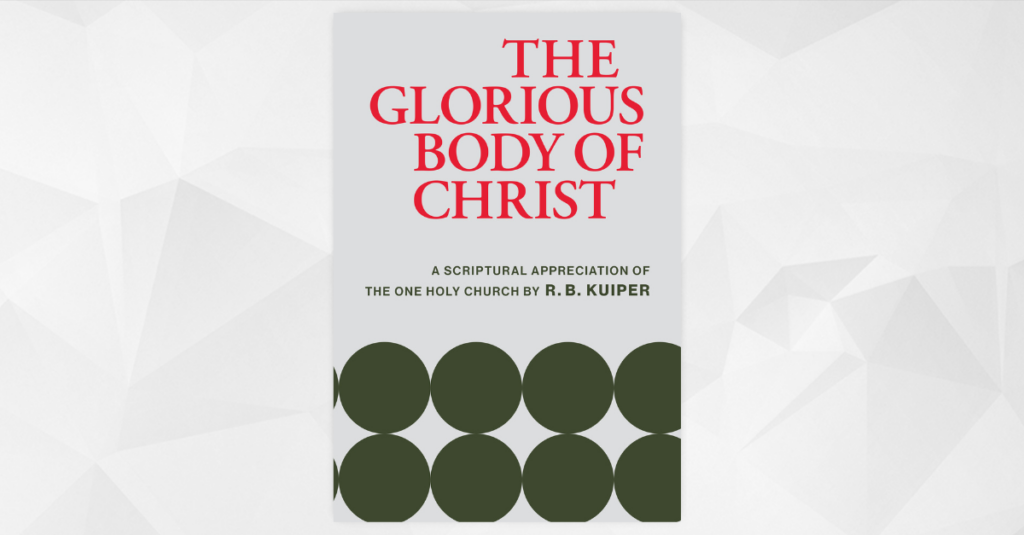
R.B. Kuiper, The Glorious Body of Christ. Banner of Truth, 1967. 416 pages.
I’d memorized the first part of the verse more than twenty years ago, as a young Christian, but it was today that I connected it to the verse that immediately follows it.
The verse I am referring to is Paul’s well-known benediction in the middle of his letter to the Ephesian church: “Now to him who is able to do far more abundantly than all that we ask or think, according to the power at work within us” (Eph. 3:20).
No doubt you’re familiar with this promise. It reminds us that our God is the God of more—far more. There are no limitations on his ability or power to do good in us and for us as his people. We are weak, but he is strong.
But to what end is this promise given? The following verse clues us in: “to him be glory in the church and in Christ Jesus throughout all generations, forever and ever. Amen.”
So, yes, God is able to do far more than all that we ask or think. And, yes, he is more than willing to exercise his power on our behalf.
But for what reason? So that his glory might be seen in his church.
The church is a place where God intends for his glory to be made visible, and though in itself the church is weak, God has everything at his disposal to make his name great among us. And this is something he’s committed to do, beyond all that we can ask or imagine.
If God is so committed to seeing his glory displayed in the church, we ought to be as well. That’s why The Glorious Body of Christ by R.B. Kuiper deserves a careful reading by a wide audience. Kuiper seeks to share “the teaching of Holy Scripture concerning the church of Christ . . . specifically its glory.” He writes in the introduction that his “chief concern is to give the reader some glimpses of the marvelous glory of the body of Christ.” This he does in 53 concise chapters. These chapters were originally published as monthly articles in the Presbyterian Standard between 1948 and 1952.
Kuiper was a minister in the Orthodox Presbyterian Church, though his aim in this book is broader than Presbyterianism. He doesn’t want to appeal only to those who share his particular ecclesiastical convictions. Rather, he writes as one who “did not have in mind any particular denomination but rather the church described in the Apostles’ Creed as ‘catholic.’” He largely accomplishes that goal, though his presbyterian polity does show up from time to time. However, even those who remain unpersuaded by his views on matters of church government will benefit from what Kuiper says concerning the identity, holiness, leadership, preaching, and mission of the church.
For pastors, this book could work well as a one-chapter-a-week read over the course of a year, perhaps on a Saturday night before preaching. Church members might also find it useful to read one of these chapters each week prior to gathering with their local church. The book can help any Christian grow their love for and dedication to the body of Christ.
“Glorious things of you are spoken, O city of God” (Ps. 87:3). This book will help you rediscover those “glorious things,” or perhaps hear them for the first time.