

The Biblical Pattern of Terrible Fathers

July 21, 2026


July 21, 2026
Abstract: Dave Kiehn traces the pattern of unfaithful fathers throughout the Old Testament, highlighting various features of these men, including passivity, indulgence, partiality, worldliness, distraction, insecurity, compromise, and shortsightedness. These negative examples serve not only as warnings but also to remind us of our insufficiency and need for God’s grace. Through faith in Christ, Christians have a heavenly Father who is perfect and good in all that he does.
Scripture does not flatter fathers. Instead, it exposes their failures. Again and again, the Bible places before us men who were chosen by God, used by God, even praised by God, yet who failed grievously in their homes. These stories are written, as the apostle Paul reminds us, “for our instruction” (1 Cor. 10:11).
This instruction is weighty, especially for pastors because their responsibilities as fathers are not an entirely private matter. God ties the credibility of spiritual leadership to the management of the household. “If someone does not know how to manage his own household, how will he care for God’s church?” (1 Tim. 3:5). The home is the proving ground of pastoral faithfulness, not a footnote to it.
In an age when ministerial success is often measured by visibility, growth, or influence, Scripture insists on a different metric: nothing less than faithfulness in the ordinary, hidden work of shepherding one’s own children. The Bible’s repeated pattern of terrible fathers serves as a warning flare, highlighting the dangerous ways men drift from faithful leadership. Pastors often drift from a godly example through silence, indulgence, compromise, or neglect.
What follows is not an exhaustive catalogue of bad fathers, but a set of recurring biblical patterns we see in them. These patterns surface across generations and contexts, and they remain painfully relevant for pastors today. By attending to them carefully, shepherds may learn not only how to avoid ruin, but how to lead with humility, clarity, and gospel hope.
The first father in Scripture sets the pattern for many who follow. Adam’s failure in the garden was not merely disobedience; it was disobedience by the abdication of duty. Genesis 3 presents Adam as standing with Eve as the serpent questions God’s Word. Adam hears the distortion. He sees the temptation unfold. And he says nothing.
Adam’s silence was not neutral. It was sinful. Adam had been charged to guard his bride Eve, along with the garden, and lead her in keeping God’s command. Instead, he withdrew and left her vulnerable to the lies of the enemy. When sin entered the world, it did not come through brute force, but through unresisted lies. Adam’s passivity left the door open for sin to come through and take up residency inside.
Paul interprets the fall through Adam’s failure of headship. Sin and death entered through one man, not because Eve sinned first, but because Adam failed to act as covenant head (Rom. 5:12–19). His silence proved catastrophic.
For pastors, this pattern should feel uncomfortably familiar. Passivity often disguises itself as peacekeeping or patience. But refusing to lead is a kind of leadership all on its own: one that points downward. Fathers who avoid instruction, correction, and spiritual initiative train their children to drift from, rather than stand on, the Rock.
In the church, passive leadership produces passive disciples. When pastors hesitate to speak clearly on sin, the congregation learns that God’s Word is optional. When fathers remain spiritually silent at home, children learn that faith belongs at church but not at the dinner table. Silence does not protect anyone. Adam’s story warns pastors that leadership withheld is leadership failed.
Eli knew his sons were corrupt. Scripture tells us plainly that Hophni and Phinehas abused their priestly office, exploited worshipers, and treated the Lord’s offering with contempt (1 Sam. 2:12–17). Sure, Eli rebuked them verbally. But he never restrained them—seemingly because Eli was complicit in their sin of indulgence. God said to Eli: “Why then do you scorn my sacrifices and my offerings that I commanded for my dwelling, and honor your sons above me by fattening yourselves on the choicest parts of every offering of my people Israel?” (1 Sam. 2:29)
God’s indictment against Eli for these things is chilling: “I declare to him that I am about to punish his house forever . . . because his sons were blaspheming God, and he did not restrain them” (1 Sam. 3:13). Eli honored his sons above the Lord, not by explicit preference but by inaction.
This pattern appears whenever fathers mistake affection for love. Eli loved his sons, but he loved them wrongly. He feared relational fallout more than divine judgment. He preferred short-term peace to long-term faithfulness.
Pastors today face this same temptation. Discipline is costly. Confrontation strains relationships. Correction risks misunderstanding. Yet Scripture is clear: love without discipline is not love at all. Refusing to restrain sin participates in it. “Whoever knows the right thing to do and fails to do it, for him it is sin” (Jas. 4:17).
In the home, indulgent fathers raise children who believe boundaries are negotiable. In the church, indulgent pastors preside over congregations that drift into disorder and doctrinal confusion. God does not judge Eli for his sons’ sins alone, but for his failure to act as a father. Shepherds must remember that holiness preserved today prevents devastation tomorrow, both in the home and the church.
Few sins fracture families as quietly and persistently as favoritism. Isaac favored Esau. Jacob favored Joseph. In both cases, the result was division, deceit, and deep resentment. Isaac’s favoritism was rooted in appetite. “Isaac loved Esau because he ate of his game, but Rebekah loved Jacob” (Gen. 25:28). Their divided affection poisoned the household.
Jacob, shaped by this environment, repeated the pattern. He clothed Joseph with a special robe and openly preferred him above his brothers (Gen. 37:3–4). The result was predictable. Jealousy festered. Hatred grew. Betrayal followed.
Favoritism teaches children that love must be competed for—to the victor go the spoils. It creates winners and losers within the same household. And it distorts the character of God, who shows no partiality.
Pastors are not immune. Favoritism may appear in subtler forms, such as unequal attention, disproportionate praise, or emotional investment in one child over another. In the church, it surfaces when leaders privilege certain families, donors, or personalities.
Partiality undermines trust. It trains people to perform rather than rest in grace. Faithful fathers and pastors must reflect the impartial love of God, who shows kindness freely and consistently.
Lot’s story is a warning about the slow danger of compromise. He did not wake up one day intending to lose his family. He simply chose what looked advantageous. He lifted his eyes, saw the fertile plains, and pitched his tent near Sodom (Gen. 13:10–12).
Proximity eventually became participation, and participation became normalization. By Genesis 19, Lot lived inside the city gates. His family had absorbed Sodom’s values. His sons-in-law dismissed a divine warning as a joke. His wife looked back, rejecting the words of the angel. His daughters carried Sodom’s ways with them even after their escape.
Lot’s compromise did not stay personal. It shaped his household. Fathers teach by what they tolerate. Children learn not only from instruction, but from what their parents move toward, excuse, or ignore.
Pastors face constant pressure to soften convictions for the sake of relevance or comfort. Yet holiness erodes slowly, not suddenly. When leaders normalize worldliness, they catechize their children and congregations in compromise. The church does not need fathers who withdraw from the world, but fathers who resist being shaped by it.
Samuel stands as a sobering reminder that public faithfulness does not guarantee private attentiveness. Scripture gives no indication that Samuel was morally corrupt or doctrinally compromised. He was a faithful prophet. Yet his sons “did not walk in his ways” and instead pursued dishonest gain (1 Sam. 8:3).
The text suggests neglect. “[Samuel] went on a circuit year by year to Bethel, Gilgal, and Mizpah. And he judged Israel in all these places. Then he would return to Ramah, for his home was there” (1 Sam. 7:16–17). His public calling eclipsed his private ministry of discipling those in his own home. The result was devastating, not only for his family but for Israel, which demanded a king in response to his sons’ failure.
Pastors are especially vulnerable here. Ministry creates endless demands. Sermons must be prepared. Crises must be managed. People must be shepherded. Yet no amount of public ministry compensates for neglected fatherhood.
Paul’s qualification for elders assumes that the home reveals the man. The church should not celebrate gifted leaders who neglect their children. Faithfulness is either holistic or it is hollow.
Saul ruled by fear rather than faith. His leadership was marked by insecurity, jealousy, and suspicion. When David’s success threatened Saul’s status, Saul turned not only against David but also against his own son, Jonathan (1 Sam. 20:30–33).
Control became Saul’s strategy for survival. Loyalty was demanded, not cultivated. Obedience was coerced, not inspired. His home mirrored his reign: volatile, fearful, and fractured. Control is a counterfeit for godly authority. It arises not from strength but from insecurity. Fathers who rule through intimidation may achieve compliance, but they destroy trust.
In the church, authoritarian leadership often masquerades as decisiveness. But fear-driven leadership produces shallow unity and quiet resentment. Gospel authority operates differently. It persuades, shepherds, and serves. Fathers and pastors must lead from confidence in God’s sovereignty, not anxiety over their position or their desire for respect.
David’s failure as a father was especially tragic because of his strengths. He was courageous, compassionate, and deeply devoted to the Lord. Yet his moral collapse with Bathsheba crippled his leadership at home.
When Amnon assaulted Tamar, David was angry but silent. When Absalom murdered Amnon, David failed to act. When Absalom rebelled, the kingdom bled. David’s passivity compounded his earlier sin. Guilt erodes courage. Unconfessed sin weakens discipline. David’s household disintegrated not because he lacked affection but because he lacked godly resolve.
Pastors must take this warning seriously. Moral failure does not remain in the shadows. It echoes off the walls of homes, destroying families and churches. Only true repentance restores fellowship with God and can heal cracked foundations.
Hezekiah’s failure was subtle. After showing Babylonian envoys of his wealth, he received word that future generations would suffer because of his pride. His response is startling: “Why not, if there will be peace and security in my days?” (2 Kgs. 20:19). This is the sin of shortsightedness. Hezekiah accepted delayed judgment with indifference because he prioritized immediate comfort over generational faithfulness. He didn’t care that his children and their children would be left paying the bill so long as he wasn’t responsible for it.
Pastors must think beyond their own tenure. Churches are normally not built for one generation alone but entrusted to generations to come. Fathers who measure success by present stability often neglect long-term spiritual health and eternal reward. Faithful leadership asks not only, “Is there peace now?” but “What peace will this produce in the future?”
The point of these warnings is not condemnation, but renewed faithfulness. Every flawed example leaves us more aware of our own need for God’s help. God reveals the insufficiency of human leadership so that his people will long for his perfect fatherhood. Human fathers fail because they are not the perfect Father.
Perhaps as you read through these patterns, you recognize more than history. You may recognize yourself. You see moments of passivity, seasons of indulgence, compromises you justified, conversations you avoided, or absence at home. Scripture does not expose these failures to crush you, but to call you out of hiding. The gospel invites honesty. God already knows where you have failed as a father. He is not surprised by your weakness, your fear, or your regret. What he requires is not self-defense but humble repentance. The same Word that names your sin also invites you to bring it into the light, where grace does its restoring work.
The good news for terrible fathers is not that the past can be undone, but that it can be redeemed. Jesus Christ came as the faithful Son who perfectly revealed the Father whom we have failed to reflect. He bore the guilt of our passivity, our anger, our neglect, and our pride. At the cross, the Father did not overlook sin; he judged it fully in his Son. And in the resurrection, God declared that forgiveness is real, cleansing is complete, and renewed obedience is possible.
Brother pastor, confess your sin. Turn from it. Ask for forgiveness where it is needed. Then, walk forward in faithfulness, trusting that God delights to restore broken fathers and families. He will use repentance as the instrument of lasting change in your children’s lives.
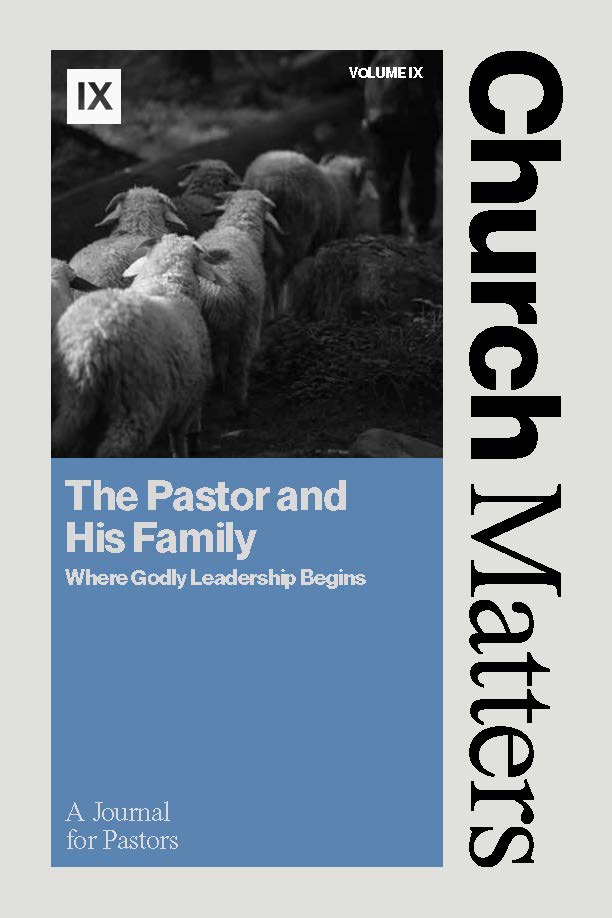
Is it possible to be “successful” behind the pulpit while being negligent in your own home? Maybe in the eyes of the world, but not according to God’s Word. Those who care for God’s household must first manage their own household well.
Go to Journal →